Yes, that is possible, see the paper at FlexHex, who offer a free tool to map directories into a different physical tree. I need this for a webserver who needs to access some files not stored under the web root.
Over the last weekend I worked on redesigning my workflow of handling PDFs while taking into account the many new capabilities of the Zotero literature management. Continue reading A workflow for managing PDFs with Zotero
There are many ways how to accidentially duplicate files: storing multiple mail attachments, copying or restoring files to a wrong directory. Here is a simple way Continue reading A little gift from Science Surf
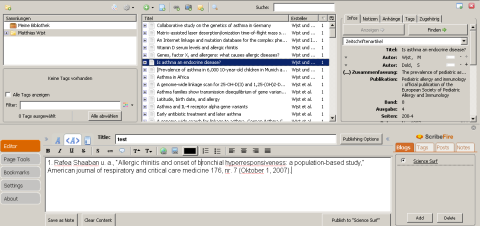
— an important question for a science blogger. The answer is yes, at least in principle, as you can see from my screenshot: I am able to drag and drop a reference from the Zotero list view into the Scribefire edit pane. As the reference appears there in full text only, I have already submitted a support request at the Scribefire site as. I think we need to implement DOI support and I will look into the possibility to write a Zotero plugin. A quick fix to reformat the dropped reference would probably be a simple bookmarklet.
BTW The Endnote import into Zotero works best with the “Refman” option on the UPPER RIGHT BAR in Endnote selected before starting the text export. The resulting text file then can be flawless imported in Zotero if it contains less than 100 or 200 references.
Zotero is a browser plugin that I am currently exploring as it can recognize PUBMED or PLoS entries and knows about Endnote/Refer/BibX export in UTF-8 format. The Open Office 2.1 insert reference macro produces a runtime error here and importing 100 references freezes my computer for about 5 minutes. Nevertheless Zotero follows a promising concept and holds much premises for the future; just discovered that data are stored in “…\zotero\zotero.sqlite”, great! one of the best available databases. This is the reason why I will

yea, yea.
As there is no central Zotero server, I wonder how I could access my local installation from different sites. The recommended portable Firefox is not really an universal solution. As with other open source databases, surrounding code of SQLITE is getting commercialized but there seems to be a free? sqlite server for download.
This is a more philosophical remark on science publication: With a technical sound solution for online referencing I expect that science blogs will get more influence while printed papers will loose their importance. Post publication peer review (attached comments) is certainly as good as pre publication peer review (that kills many new ideas, always delays publication and costs a lot of money better spent for research). You can cite me for that idea ;-)
Of a proven set of regulatory regions in zebrafish, computer programs find only between 29% and 61% of the true motifs. This does not come very much unexpected given the vast array of data shown by the Encode project. It even relates to the most basic question: What is a gene?
The more expert scientists become in molecular genetics, the less easy it is to be sure about what, if anything, a gene actually is.
iwith at least 5772 21U-RNAs? So – if I am sitting on the other side of the table when you are being examined don’t talk about junk DNA anymore, yea, yea.
I have currently a paper under submission at the EJHG that covers ethical issues of genetic testing. One of the key messages is that genetic data are not anonymous if having simply stripped of names.
A story in a completely different field confirms my fears. According to a NYT article
Last October, Netflix, the online movie rental service, announced that it would award $1 million to the first person or team who can devise a system that is 10 percent more accurate than the company’s current system for recommending movies that customers would like.
but things turned worse by an article of Narayanan und Shmatikov Continue reading Anonymizing genetic data
You may want to read the full story at Public Rambling (fiction), the NYT article of Amy Harmon (fact) or the “Peepshow” article of Marco Evers (fact) and come back here afterwards.
The recent advances in genome sequencing (and typing) has left us with an enormous amount of data. Although technology has been available for a couple of years knowledge exploded only recently, where people now may decide to participate in a genome study or even have their genes tested on their own costs at DeCodeMe, 23andme, Navigenics or other personal genome service provider.
The main question is, what do these data really mean for us? Should we start an Open Source Project Genome Explained to collect the necessary annotation rules and provide a platform to apply these rules to local data? The data mode may be quite simple: Continue reading Genome explained
Is there a working alternative to Endnote(R) or Reference Manager(R) for Open Office (noR)? The Bibliographic Project Homepage says that Continue reading bibliographic.openoffice.org.call
Last night I completed the prerelase of a new database engine that may be used both for online and offline collection of interview data and laboratory values. Continue reading Prerelease: A universal study database engine
This is a message for those people who arrived here by a Google search as their Ipaq is not working any more. Maybe my story will be helpful for you?
On another morning my Ipaq hw6515 did not respond at all – the screen simply remained black. Continue reading I did it
No, I am not converting to ZEN habits – my Ipaq is down for unknown reasons. No phone list, no todos, no calendar! To keep on working, I decided Continue reading A poor man`s organizer
Scotsman.com news reports – 25 million in trouble by 2 CDs lost, nay, nay.
is a serious issue as personal data in the internet grow exponentially. I have just recently completed a paper on informed consent in medical studies but think now it will not go far enough. In accordance with recent proposals at the Internet Governance Forum of the United Nations we might need a system that allows a personal digital right management where a server runs a checksum or does a reverse lookup before transmitting personal data – otherwise data tranfer should be aborted. See more at the EU funded project PRIME – I fear that people will no more participate in our studies if we can´t guarantee them confidentiality.
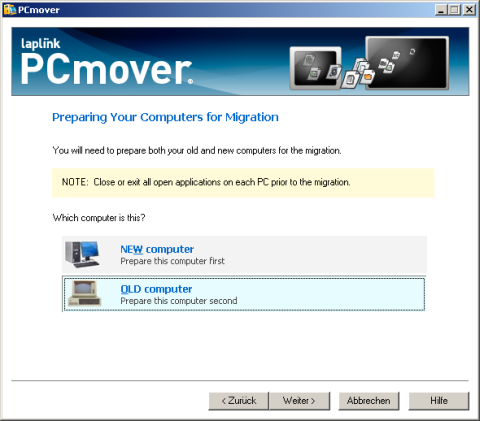
Did you ever move a windows system to another computer? Reinstalling Office and R libraries, ODBC data sources, paths, skins, shortcuts? All your emails and other data? It takes me 2 days … Fortunately there is some software that can help.
![]()