Just recently I came across a paper of David Marsh in 1992 on a major allergy gene “Fact or Fancy”. Many years later, the response is clear! Nevertheless the title remains popular at pubmed for reviews (N=42) – did they all read Asimov?
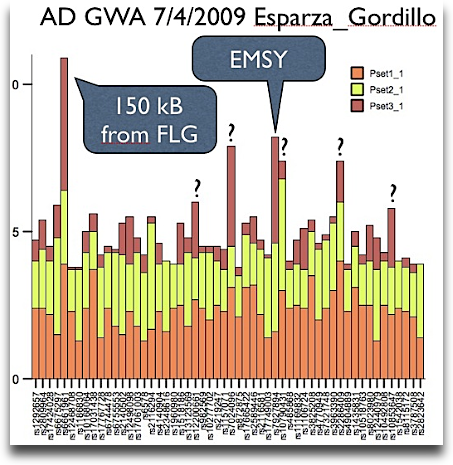
I have already seen this data in Washington and even talked to one of the two first authors (pun!) at the airport – the first genomewide scan for atopic dermatitis is now being online at the nature genetics website. The overall effects are disppointing small – my quick plot gives the cumulative (sic!) negative log p values.

Continue reading Why just C11orf30?
NYT reports that Knome plans to offer its personal gene-sequencing service to the highest bidder in an eBay auction set to begin on Friday and continue for 10 days. This will include also a private dinner Continue reading I don’t want to bid for this dinner
A new editorial in one of my most favorite journals now finds that immune cell signal transduction is just too complicated to be effectively queried using traditional methods and mindsets – something that I felt for some long time to be true not only for immunology for also for genetics, yea, yea.
There seems to be a GWAS repository that has an entry of an asthma study otherwise not known in the biomedical literature and – as see on the screenshot -results tables are empty. Continue reading Factory science
New rumors say about Wolfram alpha
In this respect it is vastly smarter than (and different from) Google. Google simply retrieves documents based on keyword searches. Google doesn’t understand the question or the answer, and doesn’t compute answers based on models of various fields of human knowledge.
…
or those who are more scientifically inclined, Stephen showed me many interesting examples — for example, Wolfram Alpha was able to solve novel numeric sequencing problems, calculus problems, and could answer questions about the human genome too.
I have applied for a test account as I am interested in methods how to deal with genomic and all the other pentabyte of data — we urgently need a paradigm shift as single genome prices will go down to 1000 €. Continue reading A better search engine for science?
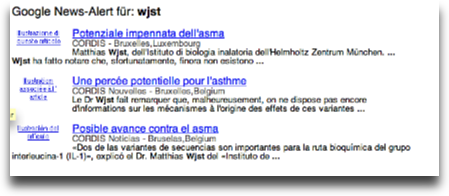
It’s a pleasant experience to write something that is being translated afterwards into so many languages afterwards. It is, however, irritating that this dissemination is irrespective of what I (and all second and third hand journalists and translators) understand of this curious world.


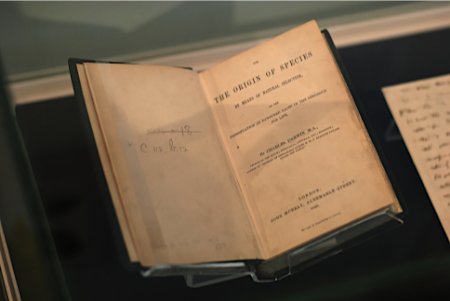
Here is a picture the original 1859 edition of the “Origins” while I still wonder if this book is about the origins or about the transitions of species.
That may be understandable as I am currently reading David Berlinski’s 2008 book “The Devil’s Delusion”. His (English) Wikipedia entry is not Continue reading Darwin and successors
It has been our gut feeling for many years – first with candidate gene studies, then with the large scale GWAs that show ridiculous low effect sizes.
A new Canadian study now reports DNA methylation at 12 K sites in dizygotic twins. Although they may not have always tested the right spots (see the CpG island shore! paper in the same issue) they were attributing discordances mainly to zygote differences Continue reading Heritability not limited to DNA sequence differences
There are not two cells in the human body that have an identical DNA sequence as detailed here earlier. But not only ageing, already basic B and T cell recombination introduces variation. And there might be more: HLA micropolymorphism! Continue reading TCR-HLA-B*4405(EENLLDFVRF)
According to Wikipedia on May 24, 1844 Samuel Morse sent his famous words “What hath God wrought” from the B&O’s Baltimore station to the Capitol Building along the wire – the first email. Continue reading First email or the driving force of science
I had to give several lectures last week explaining lay people how genomic studies work. I finally decided to compare the human DNA with the bible text – not so much in the sense of Collins’ language of God but the sheer amount of information contained in a single cell.
Here is just one slide of this talk – it seems that the comparison worked quite well – in particular the fact that if you can read a text you will not necessarily understand it. Continue reading How to explain genomics to lay people
Two days ago I heard an interesting by Andreas Beyer about using wiring diagrams as a bioinformatics tool box for simulating complex biological relationships. This is something that can be found also in this recent nat gen review but even more detailed in new work on eQTLs. So far, however, there is not proof that any of these methods behave much better than others in the absence of a gold standard in bioinformatics, yea, yea.
I had already a thread here about asthma and iatrogenic factors last month including estrogens, vaccines, antibiotics, vitamin D, paracetamol, and Caesarean section. There may be even another kid on the block: folate. At least in mice in utero supplementation with methyl donors enhances allergic airway disease Continue reading Asthma: a iatrogenic disease cont’d
Local newspapers just report a suicide – where the corpse had to be identified in the forensic department. Skin cells turned out to be male, blood cells to be female. The solution to this paradox was quite simple Continue reading A man with a female DNA