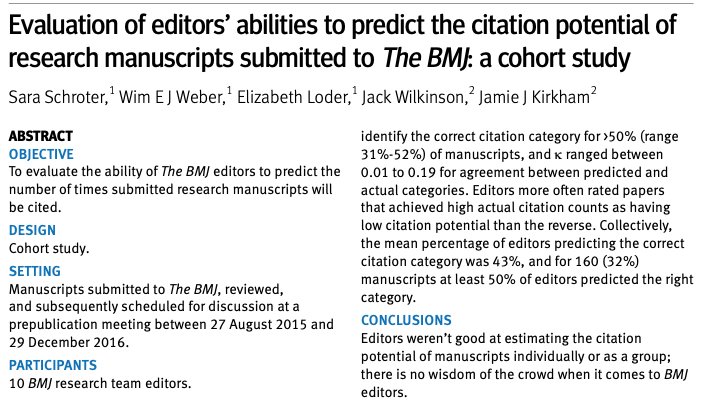
It is not a joke – it is the harsh reality – kudos to the BMJ for allowing this analysis.
CC-BY-NC Science Surf
accessed 13.03.2026
It is not a joke – it is the harsh reality – kudos to the BMJ for allowing this analysis.
A great new PNAS paper
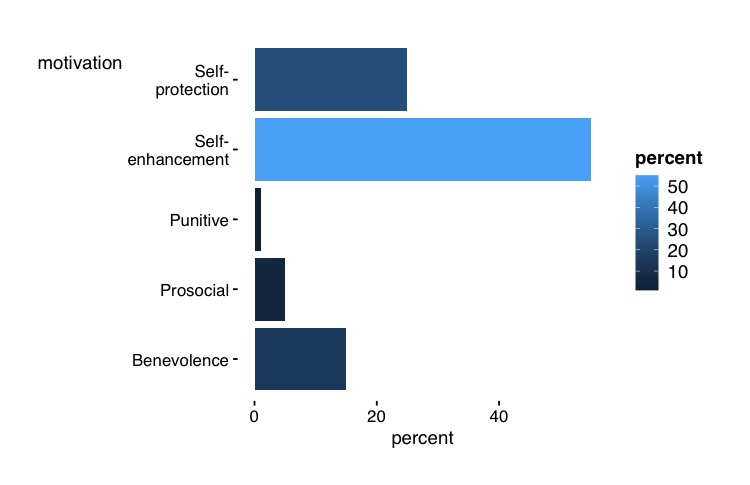
Popular narratives suggest that scientific censorship is driven by authoritarian officials with dark motives, such as dogmatism and intolerance. Our analysis suggests that scientific censorship is often driven by scientists, who are primarily motivated by self-protection, benevolence toward peer scholars, and prosocial concerns for the well-being of human social groups.
Having experienced also censorship with a scientific hypothesis I would rate the arguments just by gut feeling like so
In dem Artikel erregte ein Zitat der Chief-Editorin von Nature, Magdalena Skipper, besondere Aufmerksamkeit. Hinsichtlich des Aufdeckens gezielter Fälschungen in Forschungsartikeln hält sie fest, dass dies keineswegs Job der Reviewer ist – und fügt hinzu:
Ich möchte meine Peer-Reviewer eigentlich nicht als eine Art Polizeikommando ansehen, das solches Fehlverhalten aufspürt.
Schon im Artikel werden Editoren-Kollegen mit anderer Meinung zitiert. Für noch mehr Diskussionen sorgte Skippers Aussage indes in den Sozialen Medien. So wunderte sich etwa die australische Psychologie-Professorin Simine Vazire auf X (ehemals Twitter):
Die Zitate der Nature-Chief-Editorin Magdalena Skipper zur Frage, ob Zeitschriften im Rahmen des Peer-Review auch auf Fehler und Datenqualität prüfen sollten, überraschen mich doch sehr.
Und mit dieser Überraschung war sie bei weitem nicht allein.
Es gibt aber auch andere Stimmen. So entgegnete etwa der kanadische Biologe Zen Faulkes in einer Antwort:
Die Editorin hat recht. Das sollte nicht die Aufgabe der Peer-Reviewer sein. Es sollte die Aufgabe der Mitarbeiter des Journals sein.
Ich finde nicht, daß sie recht hat. Fehler und Datenqualität zu erkennen sollten durchaus Aufgabe der Peer Reviewer ist. Sie haben am meisten Ahnung, sie kennen sich mit den Methoden am besten aus und sie sollten sich auch mit Betrug am besten auskennen.
There are numerous tips on the internet, I have been even teaching “paper writing” for a while, but here are the ultimate recommendations
I’ve handled the review of > 1000 papers at @nature. Over time, you notice aspects of presentation on which reviewers tend to comment. In the interests of minimizing hassles during review, I offer the following suggestions (a bit targeted to climate papers).
— Michael White (@MWClimateSci) March 29, 2019
Just in case, as Twitter is dying soon and the thread archive is not working anymore, there is also a local copy.
She would reach the age of 76 next week
“we need to become experts of our own life”
There is a fascinating story from Barcelona. Maybe I missed the NYT article last year but here it is: Cell Reports 40, 111257, August 23, 2022
Joshi et al. reported that look-alike pairs identified by facial recognition algorithms share genotypes but not DNA methylomes and microbiomes.
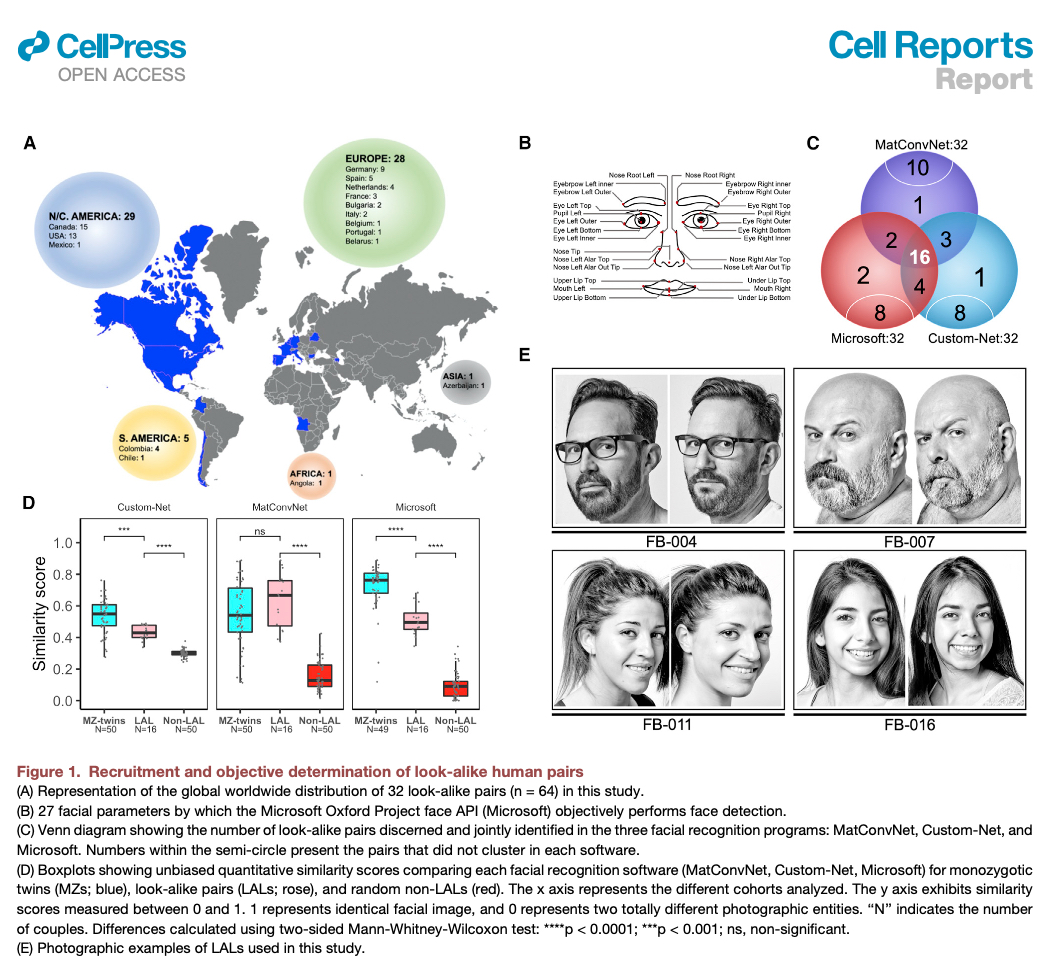
Based on an earlier study, Continue reading Inheritance of facial characteristics
According to a Chinese blogger, three publishers (not journals!) are now being blacklisted
On January 3rd, Zhejiang Gonggong University, a public university in Hangzhou, announced that all the journals of the three largest Open Access (OA) publishing houses were blacklisted, including Hindawi (acquired by Wiley in early 2021), MDPI founded by a Chinese businessman Lin Shukun, and Frontiers, which has become very popular in recent years. The university issued a notice stating that articles published by Hindawi, MDPI and Frontiers will not be included in research performance statistics.
Von den Ereignissen in der 1986 geschlossenen Asthma-Kinderheilstätte in Bad Reichenhall höre ich heute morgen zum ersten Mal in einem Podcast von BR24. Der Missbrauch geht dabei weit über die unsäglichen Verschickungsheime der 50er und 60er Jahre hinaus, die für Ihre Erziehungsmethoden berüchtigt waren. Continue reading Die Asthma-Kinderheilstätte Bad Reichenhall
The Wikipedia summarizes the “Leviathan and the air pump” book by Schaffer & Shapin
Their aim is to use a historical account of the debate over the validity of Boyle’s air pump experiments, and by extension his experimental method, to discover the origins of the credibility that we give experimentally produced facts today. The authors wish to avoid ‘The self-evident’ method, which (they explain) is when historians project the values of their current culture onto the time period that they are studying (in this case valuing the benefits of empiricism). They wish to take a “stranger’s” viewpoint when examining the debate between Hobbes and Boyle because, in the 1660s, both methods of knowledge production were well respected in the academic community.
just kidding
Last Word on Nothing writing about ChatGPT
What initiated my change of mind was playing around with some AI tools. After trying out chatGPT and Google’s AI tool, I’ve now come to the conclusion that these things are dangerous. We are living in a time when we’re bombarded with an abundance of misinformation and disinformation, and it looks like AI is about to make the problem exponentially worse by polluting our information environment with garbage. It will become increasingly difficult to determine what is true.
Is “derivate work” now equal to reality? Here is Geoff Hinton
“Godfather of AI” Geoff Hinton, in recent public talks, explains that one of the greatest risks is not that chatbots will become super-intelligent, but that they will generate text that is super-persuasive without being intelligent, in the manner of Donald Trump or Boris Johnson. In a world where evidence and logic are not respected in public debate, Hinton imagines that systems operating without evidence or logic could become our overlords by becoming superhumanly persuasive, imitating and supplanting the worst kinds of political leader.
At least in medicine there is an initiative underway where the lead author can be contacted at the address below.
In my field, the first AI consultation results look more than dangerous with one harmful response out of 20 questions.
A total of 20 questions covering various aspects of allergic rhinitis were asked. Among the answers, eight received a score of 5 (no inaccuracies), five received a score of 4 (minor non-harmful inaccuracies), six received a score of 3 (potentially misinterpretable inaccuracies) and one answer had a score of 2 (minor potentially harmful inaccuracies).
Within a few years, AI-generated content will be the microplastic of our online ecosystem (@mutinyc)
TheFrancesca Gino case is now well known [1, 2]. But this is something never seen before , a mass self-auditing effort to prove the honesty of the co-authors
More than 140 collaborators of Francesca Gino, the Harvard Business School professor who has been accused of data fabrication, have been scrambling to verify the research that they’ve published with her. On Monday, they started making their findings public.
The mass self-auditing effort, called the Many Co-Authors Project, has already initiated the retraction of at least one paper that Gino collected data for, according to one of her collaborators.
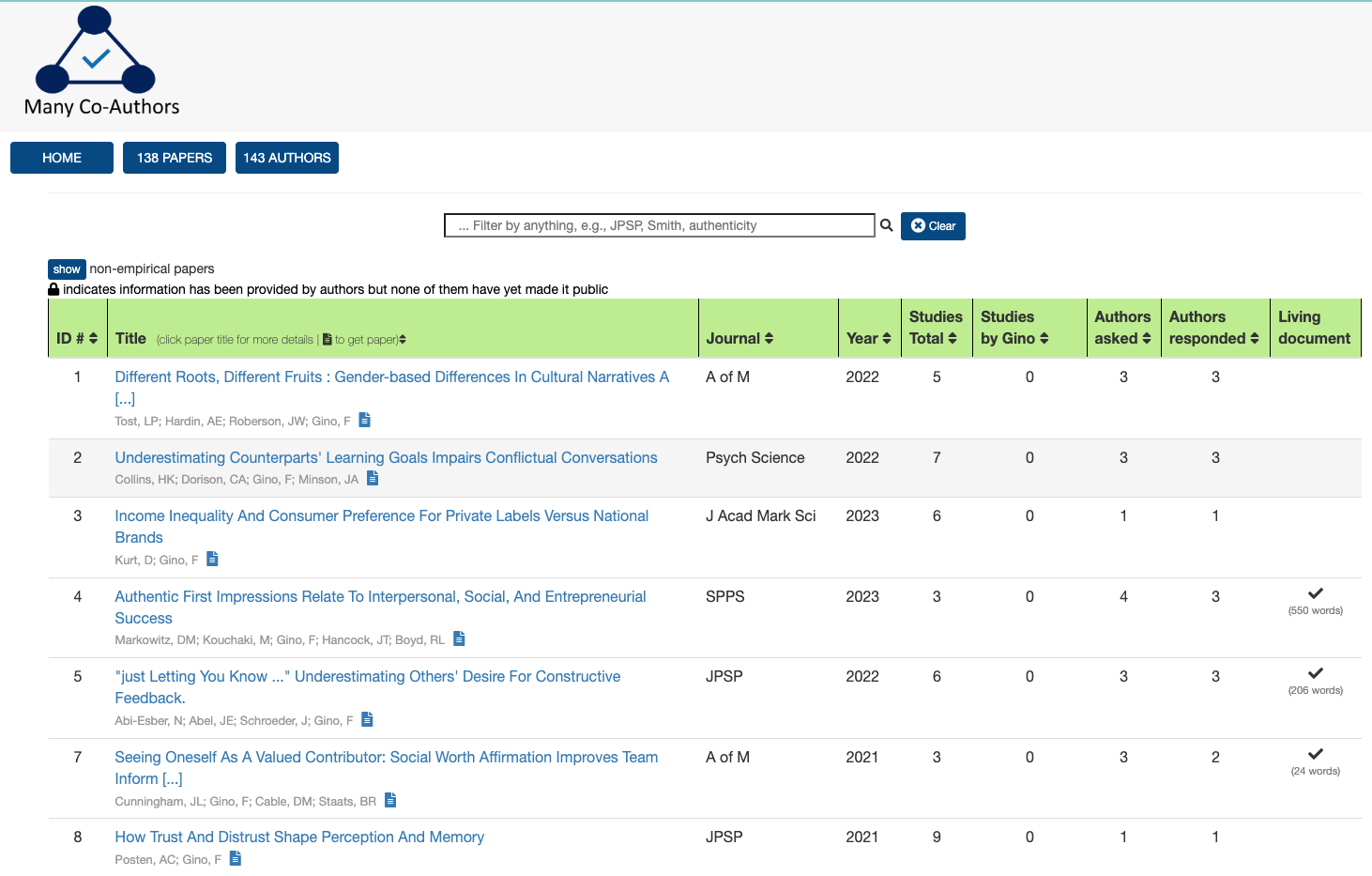
15 Nov 2024
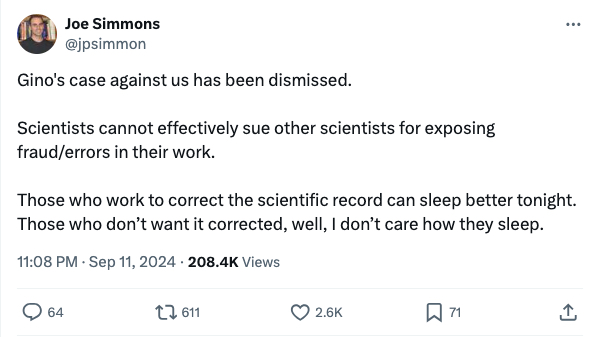
At the end it is about sleeping tonight
Maybe this is a largely irrelevant question – basically as relevant as building a museum on top of some Neanderthal 1 bones – as we can never reliable predict a complex trait just by genetics and some broken bones.
Already Virchow was wrong believing that the “Neanderthaler” was a modern human suffering from senility and malformations … Anyway, new research wants to answer this question:
Here we show that of the 51 asthma-associated loci that we surveyed, 39 carry variants that were derived in the Neanderthal lineage. The shared sequences suggest that some asthma variants may have originated from the Neanderthal genome after admixture and subsequent introgression into the Eurasian population. Of note, one variant, rs4742170, previously linked to asthma and childhood wheezing, was shown in a recent study to disrupt glucocorticoid receptor binding to a putative IL33 enhancer, and elevate enhancer activity of this key asthma gene.
Sorry to say that there are now >3000 variants associated with asthma including at least 354 coding variants while the authors used only 51 loci in their study derived from an outdated 2016 review. So we could already end up writing up a review here but the paper continues with omissions and misunderstandings
most of the Neanderthal-derived SNPs we identified, including those near the lead variants for the asthma GWAS signals, are in non-coding regions of the gene
Unfortunately we need to be exact here – not just “near” some variants. The SNP rs4742170 that they showed from the EVA database had indeed the T allele in the Vindija Neanderthal
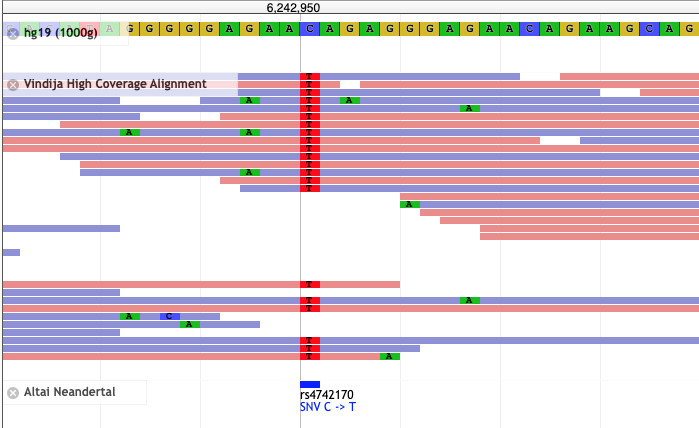
but unfortunately when going then to dbSNP it is also found in the African genome.
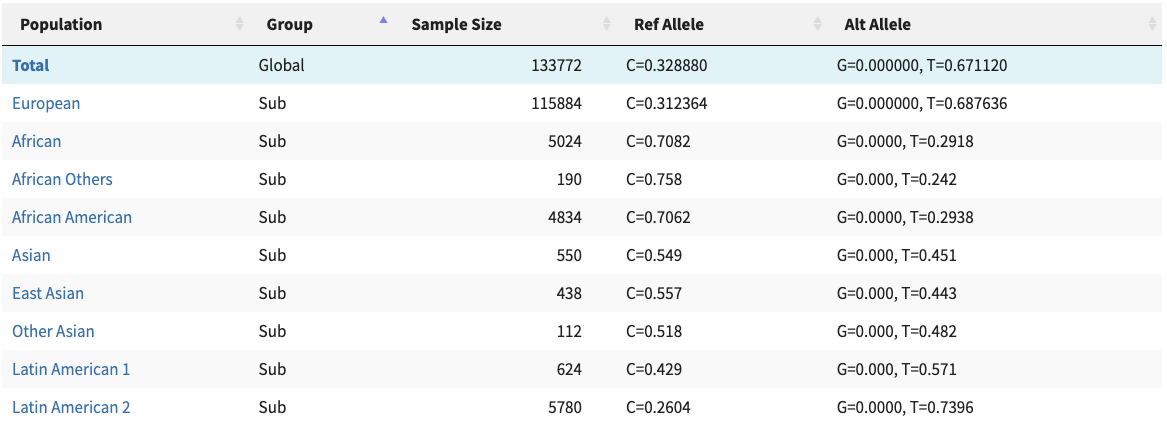
So the whole conclusion
Our findings here … add asthma to the list of diseases that could be traced back to Neanderthals
is wrong.
ein echtes Unikum der badische Archivknoten