Tom Brewster had an interesting idea: selling hsi own data. Why should anyone else make money with it?
When I decided to sell the secret details of my personal life, I had high hopes I’d get a willing buyer. It didn’t go well.
I had been curious to see if I could make money from my online information – something that data brokers across the world are doing every day; collecting it, combining it with others’ information and flogging it to marketing firms or anyone willing to pay. So I put myself on eBay.
The article is really interesting to read, yea, yea.
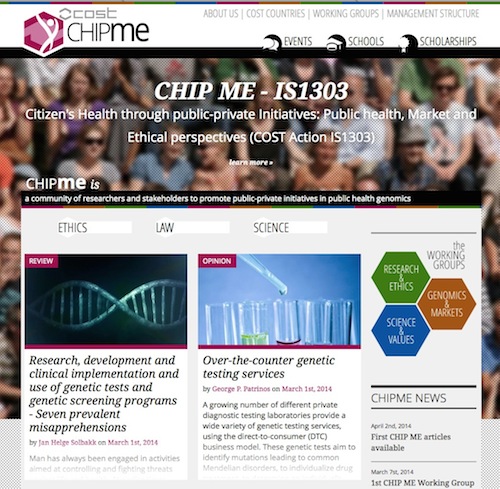
I am excited to be part of a new COST action So far only the EU description has been online while now also the brandnew website can be reached at chipme2.promoscience.com (twitter channel is @IS1303CHIPME).
From the official project description
The falling cost of genome sequencing is making genetic information more easily accessible to the ordinary citizen. The proliferation of different actors in COST countries and beyond, engaging with the generation and interpretation of genetic data represents a tremendous opportunity but also a new challenge for society. The public health care system will increasingly be asked to provide interpretation and counselling relating to genetic information that has been generated privately and to satisfy the legitimate curiosity of participants in large-scale population genetic research. Existing ethical and regulatory frameworks may not be suitable to allow an efficient and ethical meeting of demand and supply of genetic knowledge and health, as well as a virtuous interaction between public and private actors. This Action aims to improve the state of the art by creating a community of researchers and stakeholders and linking existing initiatives which bring critical expertise in bioethics, social studies of science and technology, genetic technology, information and communication technology, stakeholder deliberation, and patient centred initiatives (PCI).
I am currently writing a piece on genetic testing, basically arguing that genetic testing is still a research method and whole genome sequencing nothing for prime time as basically now summarized also in JAMA:
In this exploratory study of 12 volunteer adults, the use of WGS was associated with incomplete coverage of inherited disease genes, low reproducibility of detection of genetic variation with the highest potential clinical effects, and uncertainty about clinically reportable findings. In certain cases, WGS will identify clinically actionable genetic variants warranting early medical intervention. These issues should be considered when determining the role of WGS in clinical medicine.
Maybe the judgment of any scientific method was largely limited to experts about 20 years ago. You had to know something about research, you had to go to a library, you had to find the relevant information and eventually put it into the right context. Only a few people and only a few journalists could do that. (and only the latter would even publish their opinion).
This has completely changed with so many research papers now being published online. There is no more gate, no more gatekeeper. It means, however, that research papers are frequently misinterpreted – from patient advocacy groups to companies to medical doctors. I would wish that research papers would carry a “For research use only!” label as printed on many bottles with enzymes, antibodies and alike (Medical information is otherwise still restricted in Germany to physicians, pharmacies and medical staff). Given that rather muddle-headed situation in genetic testing, I think the new JAMA paper is a welcome recommendation for everybody!
There was the 2077 Goh PNAS paper using that title. And it is a sound approach probably better than any division of chapters in Harrison’s Internal Medicine!
A network of disorders and disease genes linked by known disorder–gene associations offers a platform to explore in a single graph-theoretic framework all known phenotype and disease gene associations, indicating the common genetic origin of many diseases. Genes associated with similar disorders show both higher likelihood of physical interactions between their products and higher expression profiling similarity for their transcripts, supporting the existence of distinct disease-specific functional modules. We find that essential human genes are likely to encode hub proteins and are expressed widely in most tissues.
When sorting out old boookmarks to numerous internet articles and papers that I wanted to read over the past years, but never did, I came across “Ignore everybody”. The website is still up after all the years and has some interesting proposals
And I knew already that his grave is on the Kensal Green Cemetry in London. Although the description at findagrave is correct, I needed additional help of the cemetry – Ioannis Bostock (1773-1846) is buried in grave number 6263, square 102. It is a portland stone pedestal with an urn on it (he died of cholera) but the inscription is very faint after nearly 170 years and reads
I see spinners everywhere – although I once learned that this is just poor website design. There are even spinner factories to create you own custom waiting room.
As I am doing a lot of time consuming jpg manipulation here and didn’t want to further increase any server overhead, I went back to rather old fashioned method – the turning slash known from old UNIX and DOS times. It expands my previous article on avoid-browser-flickering-with-dark-backgrounds writing to the preloader div and stopping after loading the iframe.
var str = "|/-\\";
var i = 1;
function myLoop () {
   setTimeout(function () {
      j=str.charAt(i%(str.length));
      $('#preload').text( i ) ;
      i++;
      if (i<99) myLoop();
   }, 150)
}
myLoop();
$(function(){
    $('#iframe').load(function(){
        i=99;
    });
});
What is it, Davis asks, that makes certain thinkers – Marx, Freud, Nietzsche – legendary? “It has long been thought that a theorist is considered great because his theories are true,” he writes, “but this is false. A theorist is considered great, not because his theories are true, but because they are interesting.”
Vitamin D level is an activity or lifestyle marker, although this has been largely neglected in the medical literature, maybe except Gannage 2000, Hyppönen 2007, Sohl 2013 and Choi 213. A new paper by de Rui in PLoS now shows that
serum 25OHD levels were significantly higher in individuals who engaged in outdoor pastimes … compared to those who did not. In particular, subjects regularly practicing gardening or cycling had higher serum 25OHD levels than those who did not, whereas 25OHD levels differed little between subjects who did or did not undertake indoor activities.
This is the combination that I tried today on a cycle route across Munich. And it is funny to see that there are some hidden bike paths that I was not aware off – the picture shows Schloß Blutenburg where I did not know this track along Pippinger Straße.
Aus Seeberger, Schamlose Neugier, Integral München, 2012, S.213:
Es gibt Menschen deren Weltbild gleicht einem Anwesen, bei dem man “eine Mauer um sich herum baut, diese mit Stacheldraht und Glassplittern versieht und Patrouillen ausschickt, um eingebildete oder echte Bedrohungen zu verjagen” wie der Schriftsteller Göran Tunström einmal schrieb. Während bei anderen die Weltanschauung wie “ein großer Hof ohne Mauer und Zaun ist, wo die tagsüber frei umherstreunden Ansichten abends ruhig nach Hause trotten, um Seite an Seite einzuschlafen”.
There is no ultimate solution to avoid the white phase when switching pages in the browser.
Here is a rather simple strategy using embedded pictures. This is usually not recommended as the necessary base64 encoding includes quite some overhead. It influences, however, the browser rendering by basically blocking the download of the remaining page which is probably the anti-flickering effect.
Works mostly, but not always. Another interesting approach has been suggested by another user, eg decreasing page loading time by async loading before switching between pages. I didn’t like that so much as it keeps the pages in your browser piling up.
So finally I did a small page only with a large iframe that is covered by a black div and removed only after loading the iframe content. Works on all tested browsers.
There seem to be million of ways to do that – here is the most parsimonious solution that works for me even under difficult conditions and in different browsers.
// should be run in a $(document).ready(function(){ bracket });
// if there is no cookie we set one
if (document.cookie.indexOf("color")!== -1 {
  document.cookie = "color=white";
}
// we need a body class without any background definition
// and a class for body.black that has background:black
if (document.cookie.indexOf("black") === -1) {
  // switch to the new .black class
  $("body").toggleClass("black");
  // this is also possible in the iframe
  $(#iframe").contents().find("body").toggleClass("black");
}
// link or whatever is being clicked for the effect
$(".place").click(function () {
if (document.cookie.indexOf("white") !== -1) {
  document.cookie = "color=black";
}
else {
  document.cookie = "color=white";
}
// reload page with a small delay
setTimeout( function() { location.reload() }, 250 );