All posts by admin

The lying Dutchman

Another series of faked studies are reported by washingtonpost

“Many of Stapel’s students graduated without having ever run an experiment, the report says. Stapel told them that their time was better spent analyzing data and writing. The commission writes that Stapel was ’lord of the data’ in his collaborations. It says colleagues or students who asked to see raw data were given excuses or even threatened and insulted.”


CC-BY-NC Science Surf accessed 18.01.2026

Make hypotheses!

The main challenge for bioinformatics is certainly not to stop at the description of all these nice networks and pathways but to develop hypotheses that add to our understanding (and that may be tested further). So, I am a little bit late to say that I liked the presentation of Sascha Sauer ( MPG Berlin ) at a meeting Paris at May 31, 2011 on genomic epidemiology using the title “Make hypotheses”. Continue reading Make hypotheses!


CC-BY-NC Science Surf accessed 18.01.2026

Too much to read too little time

I didn’t find so much time to update the blog during the past few months – there are too many attractions out there, and so many interesting things to do. The never ending problem is that there is too much to read and too little time. This is, however, what also other people find, for example genomeweb.com

Pedro Beltrao at the Public Rambling blog says there never seems to be enough time to keep up with all the literature researchers keep churning out. In 2009, 848,865 papers were added to PubMed, he says — that’s something like 1.6 papers per minute. While there’s definitely no scarcity of outlets to publish, is anyone even paying attention?

Or the Latest Everything blog

From a half-forgotten Einstein quote to the complete works of J. S. Bach, everything is instantly available. But what can we really do with it all? A HALF-CENTURY ago Marshall McLuhan wrote: “We are today as far into the electric age as the Elizabethans had advanced into the typographical and mechanical age. And we are experiencing the same confusions and indecisions which they had felt when living simultaneously in two contrasted forms of society and experience.”

who republishes theNew Scientist article (04 April 2011) pp. 1-3 in Surfing the data flood: Continue reading Too much to read too little time


CC-BY-NC Science Surf accessed 18.01.2026

Computers are like bicycles for our mind (Steve Jobs)

or in his won words

Your time is limited, so don’t waste it living someone else’s life. Don’t be trapped by dogma – which is living with the results of other people’s thinking. Don’t let the noise of other’s opinions drown out your own inner voice. And most important, have the courage to follow your heart and intuition. They somehow already know what you truly want to become. Everything else is secondary.


CC-BY-NC Science Surf accessed 18.01.2026

It’s all electric now … The 1200 Watt bicylce

There has been so much progress with electric motors and high capacity batteries finally reaching widespread use. There are kayaks with an electrict support (Torqeed here in Starnberg, that I wished to have one  yesterday at Ammersee). There are engines for ultralight planes like the Electraflyer while I just read at science.slashdot about an electric airplance.

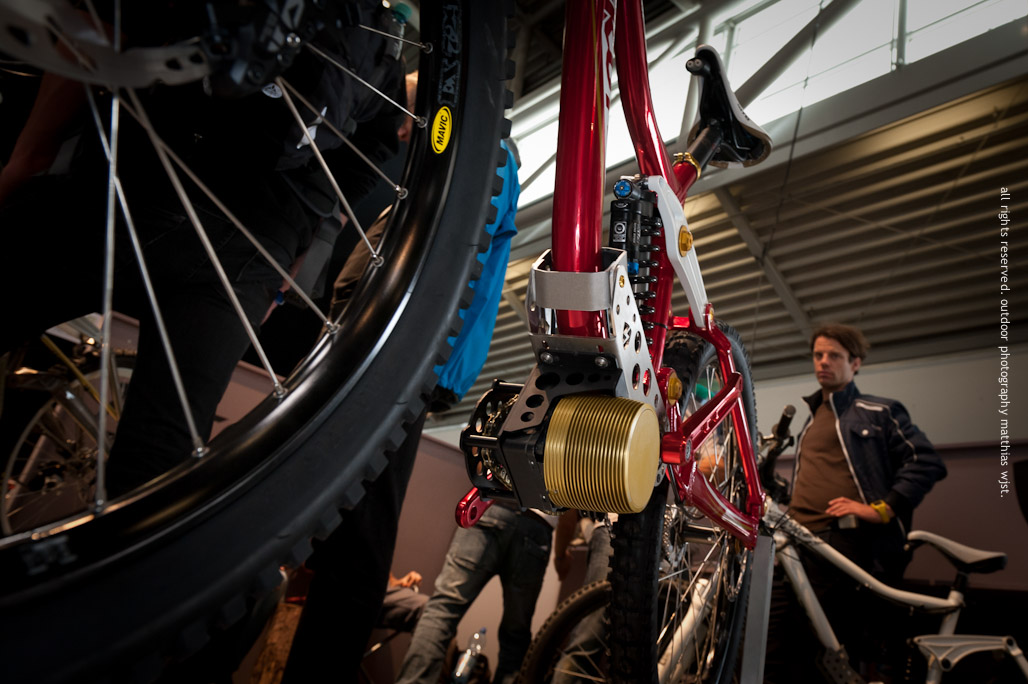
The most fascinating piece, however, I have seen last Sunday at bike expo here in Munich is  a 1200 Watt kit that can be mounted on most frames of current MTBs. Tthat’s a lot of savings compared to buying a custom built e-bike like the KTM eGnition, Elmoto, eRockit, Grace or eSpire that all come at weights of 25-35 kg.

The kit will be sold by the next month by ego-kits.com while here are two pictures from the Munich fair.


Continue reading It’s all electric now … The 1200 Watt bicylce


CC-BY-NC Science Surf accessed 18.01.2026

Science is an emergent system too

From Edge / NY Times

We often try to understand problems by taking apart and studying their constituent parts. But emergent problems can’t be understood this way. Emergent systems are ones in which many different elements interact. The pattern of interaction then produces a new element that is greater than the sum of the parts, which then exercises a top-down influence on the constituent elements. Continue reading Science is an emergent system too


CC-BY-NC Science Surf accessed 18.01.2026

Less than one mistake in every 6 million deliveries

I have seen recently a TV documentation about the Dabbawalas in Mumbai who deliver freshly cooked food to the workplaces and return the empty boxes back to the customer’s home. According to Wikiedia.

In 2002, Forbes Magazine found its reliability to be that of a six sigma standard. More than 175,000 or 200,000 lunch boxes get moved every day by an estimated 4,500 to 5,000 dabbawalas, all with an extremely small nominal fee and with utmost punctuality Continue reading Less than one mistake in every 6 million deliveries


CC-BY-NC Science Surf accessed 18.01.2026

A Mac OSX journalling error can inhibit the boot disk to be mounted

The screenshot below shows my desperate search why my Macbook wouldn’t boot again (following a cold reset writing a large Photoshop CS5 file for more than 15 minutes).

The verbose boot mode (APPLE+S) showed some error with the journalling system, basically an error as described at the currently non functioning Apple Support Board

jnl: replay_journal: bad block list header @ 0x4bra50 (checksum 0xega0fee1 != 0x927a5993)
jnl: journal_open: Error replaying the journal!
hfs: early jnl init: failed to open/create the journal (retval 0).

Unfortunately nothing helped. Booting from an external disk just showed a normal, error-free HD in disk utility. Continue reading A Mac OSX journalling error can inhibit the boot disk to be mounted


CC-BY-NC Science Surf accessed 18.01.2026

Will the bacterial flora protect you from you allergies?

Here is another post as the field seems to progress so fast with a new study on enterotypes of the human gut microbiome from

22 newly sequenced faecal metagenomes of individuals from four countries with previously published data sets, here we identify three robust clusters (referred to as enterotypes hereafter) that are not nation or continent specific.

The 3 clusters are Bacteroides (enterotype 1), Prevotella (enterotype 2) and Ruminococcus (enterotype 3) – no idea if these are under selective pressure from the host (genes!), from enviroment (antibiotics!) or from microbial competitors. When we look, however, at another study published also last week at Science magazine, it seems that at least one cluster has it’s own trick to get the right of residence by synthesizing a symbiosis factor. Continue reading Will the bacterial flora protect you from you allergies?


CC-BY-NC Science Surf accessed 18.01.2026

LIMIT TO 5! What about a maximum of 5 papers per year per scientist?

Undoubtly, there is an avalanche of poor research – as the Chronicle wrote last June, “we must stop the avalanche of low-quality research

the amount of redundant, inconsequential, and outright poor research has swelled in recent decades, filling countless pages in journals and monographs. Consider this tally from Science two decades ago: Only 45 percent of the articles published in the 4,500 top scientific journals were cited within the first five years after publication. In recent years, the figure seems to have dropped further

Also Genomeweb writes

Pedro Beltrao at the Public Rambling blog says there never seems to be enough time to keep up with all the literature researchers keep churning out. In 2009, 848,865 papers were added to PubMed, he says — that’s something like 1.6 papers per minute.

Continuing a discussion Continue reading LIMIT TO 5! What about a maximum of 5 papers per year per scientist?


CC-BY-NC Science Surf accessed 18.01.2026

Gambling with the planet

Found at project-syndicate.org, a piece by Joseph E. Stiglitz (Professor at Columbia University and a Nobel laureate in Economics):

In the end, those gambling in Las Vegas lose more than they gain. As a society, we are gambling – with our big banks, with our nuclear power facilities, with our planet. As in Las Vegas, the lucky few – the bankers that put our economy at risk and the owners of energy companies that put our planet at risk – may walk off with a mint. But on average and almost certainly, we as a society, like all gamblers, will lose.
That, unfortunately, is a lesson of Japan’s disaster that we continue to ignore at our peril.


CC-BY-NC Science Surf accessed 18.01.2026