CC-BY-NC Science Surf , accessed 03.04.2026
This is basically an update of my 2017 Allergy paper where I asked about sequelae of early vitamin D supplementation.
Two extensively examined hypotheses are the hygiene hypothesis (lack of protective bacterial exposure which leads to subsequent allergy) and the vitamin D hypothesis (early vitamin D supplementation sensitizes newborns against allergens) … The interesting question is: Are these concepts exclusive? … There is some preliminary evidence that – like many other environmental factors –vitamin D may modify the human microbiome.
Only yesterday a paper popped up during a presentation of Amelie Baud about the influence of social partners and the gut microbiome. This 2018 study tested gut microbial composition from 16S rRNA sequencing during the first year of life and subsequent risk of asthma in 690 participants
1-year-old children with an immature microbial composition have an increased risk of asthma at age 5 year … the microbial composition was not affected by maternal asthma status suggests that only susceptible children, exposed to inappropriate microbial stimulation during the first year of life, may express their inherited asthma risk …. The five most discriminating indicator OTUs for each cluster were identified for PAM cluster 1 as Enterobacteriaceae, Staphylococcus, Streptococcus, Bifidobacterium and Enterococcus, and for PAM cluster 2 as Faecalibacterium, Bacteroides(x3), and Anaerostipes … the risk of developing persistent asthma was increased (adjusted hazard ratio (aHR) 2.87 (1.25−6.55), P = 0.013) if the microbiome remained in PAM cluster 1 at age 1.
IMHO this doesn’t look very much like direct microbiome effects but some colliding factor. The authors discuss cesarean section-birth and antibiotics as relevant factors while I wonder why the last author (who is a known pro vitamin D lobbyist ) doesn’t take into account vitamin D here?
My 2017 review summarized only early results, where there are now many more robust studies like the 2019 Naderpoor study
there was a significant association between community composition and vitamin D supplementation at the genus level. The vitamin D group had a higher abundance of genus Lachnospira, and lower abundance of genus Blautia (linear discriminate analysis >3.0). Moreover, individuals with 25(OH)D >75 nmol/L had a higher abundance of genus Coprococcus and lower abundance of genus Ruminococcus compared to those with 25(OH)D <50 nmol/L.
or the 2020 Singh paper
Vitamin D supplementation significantly increased gut microbial diversity. Specifically, the Bacteroidetes to Firmicutes ratio increased, along with the abundance of the health-promoting probiotic taxa Akkermansia and Bifidobacterium. Significant variations in the two-dominant genera, Bacteroides and Prevotella, indicated a variation in enterotypes following supplementation.
So is the microbiome just an indicator of vitamin D exposure in genetic susceptible children?
On Aug 12, Science magazine published a strange journalistic article about an ongoing vitamin D asthma study. I responded on the next day while also the former editor-in-chief of Science Jeremy Berg noted
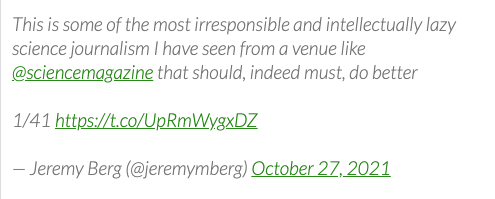
Science Mag then printed also a longer rebuttal of Dr. Berg
Piller minimizes the rationale used to select the placebo-controlled trial design and suggests that there is agreement that such a design is unethical… The News story notes that the majority of children in the trial were Black and states that this constitutes overrepresentation… Rather than being criticized, this trial should be commended for inclusion of appropriate trial participants…. Piller writes that participants were at increased risk of fractures and that the nine bone fractures experienced by study participants were more than anticipated, without specifying the magnitude of any increased risk or the anticipated number of fractures. However, there is no consensus that any increased risk exists…
Piller misrepresents the Vitamin D Kids Asthma Study (“Vit-D-Kids” or “VDKA”) . He reports concerns about the study’s design, participant safety and selection, consent forms, and report trans-parency. These doubts are unfounded. VDKA ethically investigated a potentially important treatment for childhood asthma.
Unfortunately the concluding statement of the news editor Tim Appenzeller is so much out of this world that I would recommend to search now not only for another news correspondent but also another news editor.
Edit 18 Jan 2025
Es gibt diverse Pro Vitamin D Webseiten, die den Gebrauch von Vitamin D als Rattengift (Rodentizid) bestreiten etwa das “Institut VitaminDelta, Dr. med. Raimund von Helden, Timmerschlade 14, 57368 Lennestadt” Zitat
… wurde ab 1984 wieder aufgegeben, weil die Ratten meist keinen Schaden nahmen.
Das ist Unsinn, Cholecalciferol wird sogar vermehrt wegen Resistenzen gegen Antikoagulantien eingesetzt. Fraßköder sind ab 2mg/kg wegen der Hypercalcämie auch für Haustiere wie Hund oder Katze tödlich.
Eine Pressemitteilung des Bundesverbandes aller Verbraucherzentralen weist auf ein Urteil des Landgerichts München I hin:
Erfolg gegen irreführende Werbung bei Nahrung für Kleinkinder: Das Landgericht München I hat einer Klage des Verbraucherzentrale Bundesverbands (vzbv) gegen die Hipp GmbH & Co. Vertrieb KG Recht gegeben. Demnach sind mehrdeutige Werbeaussagen zum angeblichen Vitamin D- und Calciumbedarf von Kindern bei Milchersatzprodukten untersagt. „Verbraucherinnen und Verbraucher müssen bei Lebensmitteln für Kleinkinder darauf vertrauen können, dass die Unternehmen besonders verantwortungsbewusst handeln. Dazu gehören klare und deutliche Informationen über Vitamine und Nährstoffe“, sagt Susanne Einsiedler, Rechtsreferentin beim vzbv. „Eltern sollten nicht den Eindruck bekommen, dass bestimmte Produkte nötig sind, damit ihr Kind ausreichend versorgt wird. Kinder über einem Jahr brauchen in der Regel keine speziellen Lebensmittel“.
Auch wenn das Urteil noch nicht rechtskräftig ist, gehe ich noch einen Schritt weiter, es braucht überhaupt keinen Vitamin D Zusatz in der Säuglingsmilch, auch nicht in der Anfangsmilch, es wird längst zuviel direkt supplementiert.
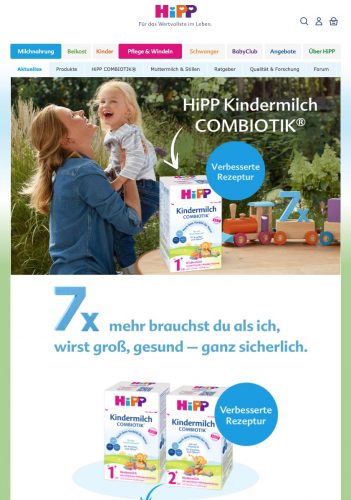
Der Vitamin D Hype schadet mehr, als dass er nützt. Orales Vitamin D kann zu späteren Allergien führen, auch wenn Fachgesellschaften die Vitamin D Supplementierung aus Tradition weiterhin unkritisch sehen.
Es ist ja ein lustiger Experte, dieser Dr. med Jürgen Hower, den HiPP da auf der Webseite in einem “Interview” präsentiert neben der hauseigenen Wissenschaftlerin. Seine wissenschaftliche Leistung in der Endokrinologie besteht darin, bei Kindern in seiner Gemeinschaftspraxis Vitamin D Spiegel bestimmt zu haben. Ansonsten vermarktet er mit Vitamin D gepanschte Schokolade als “Dr. Chococo”.
Nichts Neues also unter der Sonne – ich erinnere mich an Aktenberge im Bundesarchiv Berlin, in denen sich einschlägige Geschäftemacher schon vor 80 Jahren einen jahrelangen Streit mit den Behörden lieferten.
Clemens von Pirquet, when working on horse serum injections, coined the word allergy in 1906. It is largely unknown that his Vienna clinic was also hightly active in “vitamin D” research as described in a new review by Bouillon which cites the Dame Chick lecture Continue reading Pirquet: Allergy and Vitamin D
I remember an old vitamin D book – I believe it was Feldman’s Vitamin D – that argues that if we are going down the Transsahara Route (Algier-Lagos) human skin color gets always darker towards Tamanrasset due to increased solar power- also known known as the Loomis hypothesis (Science 1967).
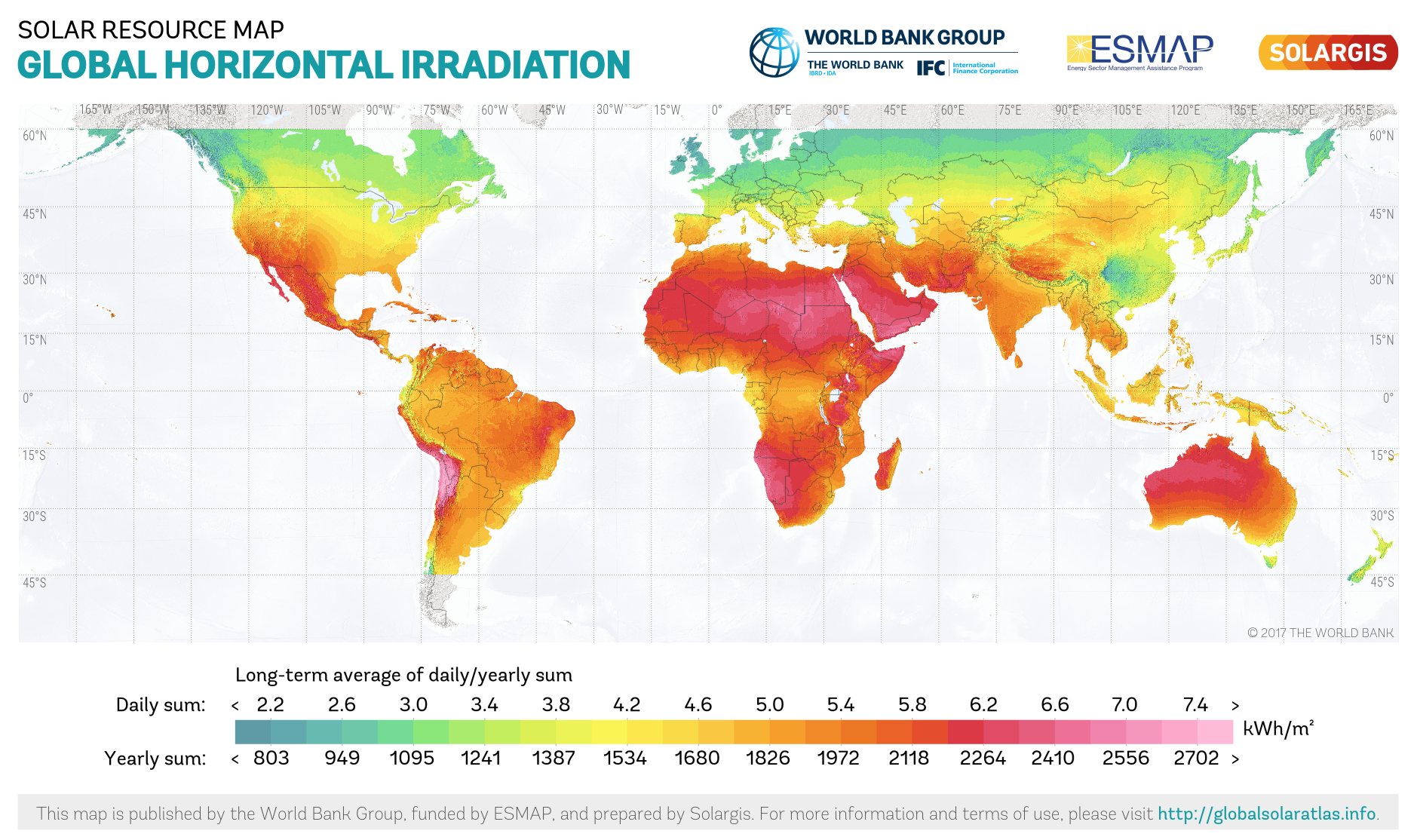
So , let’s have a look at three maps. Solar power first.
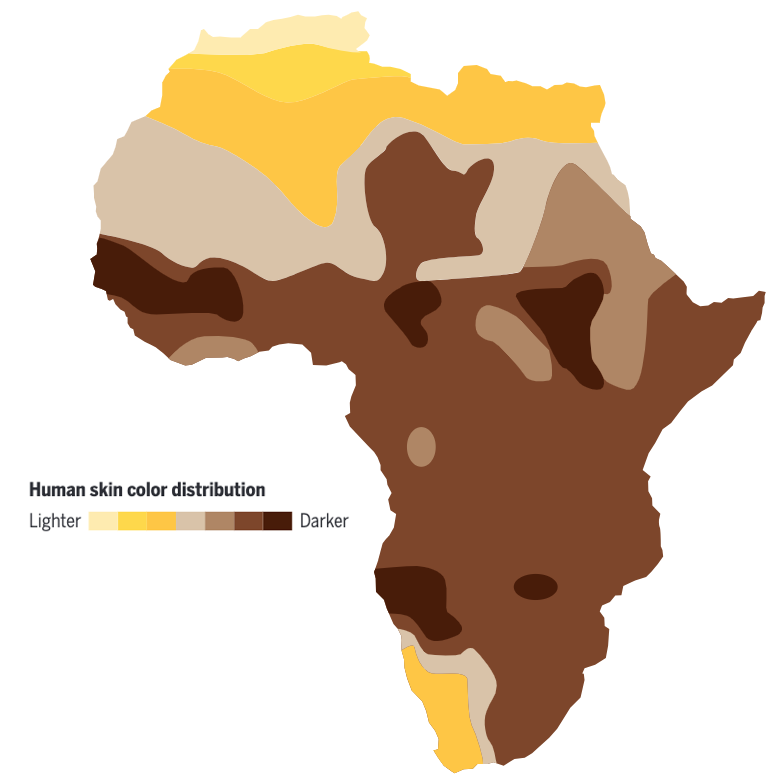
Second, skin tones – the Tamanrasset observation is correct but the overall picture does not match the Loomis hypothesis.
Neither does the new vitamin D map published last week in the Lancet.
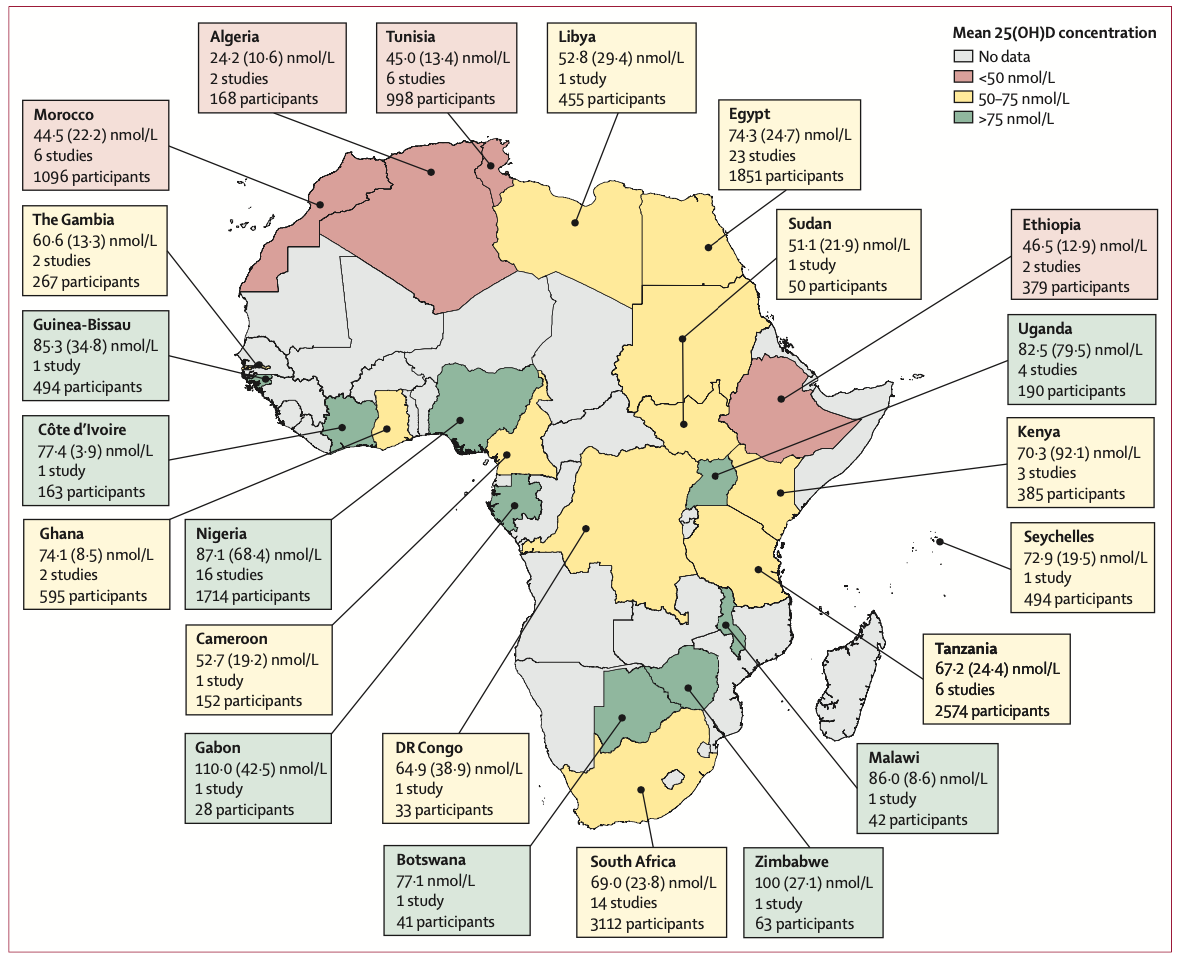
No need to calculate any formal correlation coefficient. – maps are patchy but let me conclude that either the vitamin D data or the Loomis hypothesis is wrong.
Here is the math: 1 µg/L D3 => 40 IU/L D3 => 2,5 nmol/L D3
The detection limit in breast milk is 0,2 nmol/L = 0,08/µg/L = 3,2 IU/L according to vid Streym who measured a median of 0.34 nmol/L 25-OH-D3 in hind milk which is approx 5,4 IU/L.
Li-Chieh Wang gives no detection limit but measures approx 5 ng/mL = 5.000 ng/L = 5 µg/L = 12,5 nmol/L D3 in breast milk equivalent to 200 IU/L, the 40fold amount to vid Streym.
What is correct?
It is always nice to see an own study 15 years later appearing in a meta-analysis. A new paper in the Annals of Allergy, Asthma and Immunology now shows the results of 17 case–control studies.
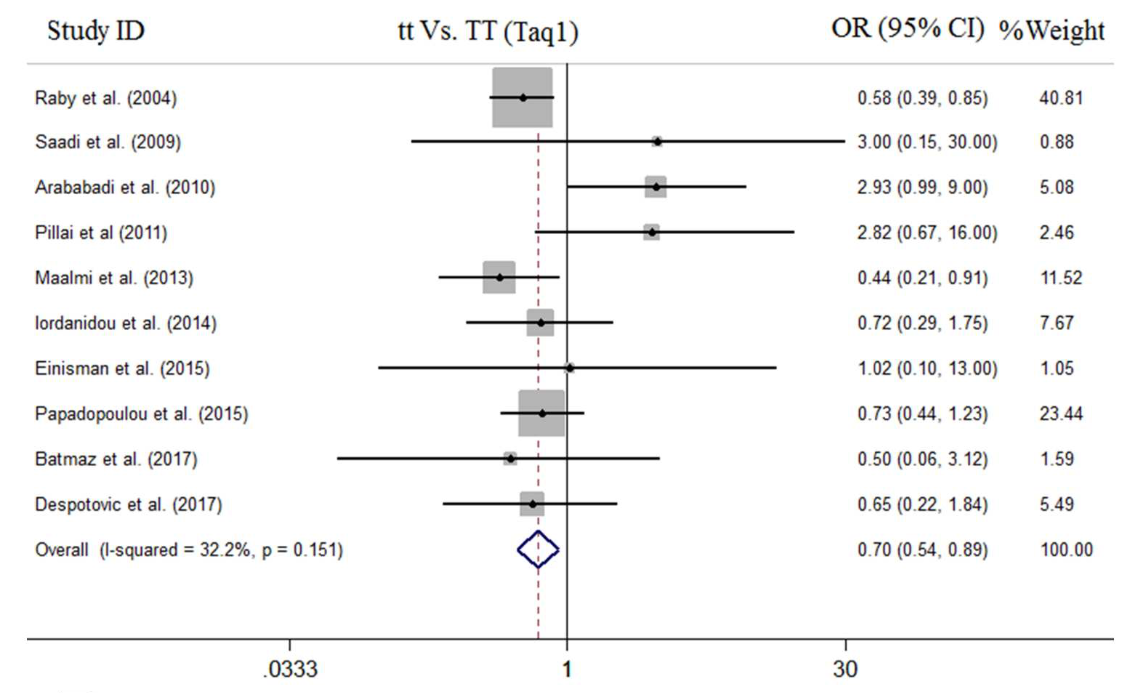
We are in line #1…
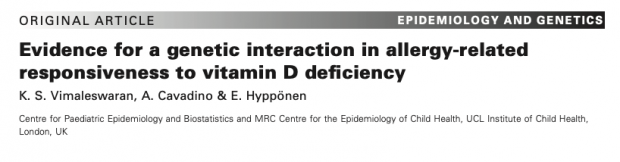
Another nice paper on a genetic interaction is Vimaleswaran et al.
A new study by Urashima et al. shows that sensitization to cow’s milk and food allergy, including CMA and anaphylaxis, is preventable by avoiding CMF (cow milk formula) supplementation for at least the first few days of life. Although examined only indirectly in this study, vitamin D supplementation seems to be involved in the sensitization process.
Note to self – here is a list of all vitamin D / allergy related clinical trials following the first case report was Moneret-Vautrin DA, Hatahet R, Kanny G, Ait-Djafer Z. Allergenic peanut oil in milk formulas. The Lancet 1991; 338: 1149. doi: 10.1016/0140-6736(91)92008-p.
1. De Montis G, Gendrel D, Chemillier-Truong M, Dupont C. Sensitisation to peanut and vitamin D oily preparations. The Lancet 1993; 341: 1411. doi: 10.1016/0140-6736(93)90976-N.
2. De Montis G, Gendrel D, Chemillier-Truong M, Dupont C. [Peanut sensitization and oily solution vitamin preparations]. Arch Pediatr 1995;2(1):25-8. doi: 10.1016/0929-693x(96)89804-6.
3. Rueter K, Jones AP, Siafarikas A, Lim EM, Bear N, Noakes PS, et al. Direct infant UV light exposure is associated with eczema and immune development. J Allergy Clin Immunol 2018; in press, doi: 10.1016/j.jaci.2018.08.037.
4. Rosendahl J, Pelkonen AS, Helve O, et al. High-Dose Vitamin D Supplementation Does Not Prevent Allergic Sensitization of Infants. J Pediatr. 2019 Jun;209:139-145.e1. doi: 10.1016/j.jpeds.2019.02.021
The Urashima study is accompanied by a valuable editorial of George du Toit and Kari Nadeau
There is currently a lack of consensus among national allergy societies .. Although the EAACI3 and American Academy of Allergy, Asthma and Immunology (AAAI) currently recommend the use of hypoallergenic formulas in infants at high risk of allergy, the Australian Society of Clinical Immunology and Allergy does not. The EAACI and the AAAI are likely to reconsider their guidelines because results of more re- cent studies have been contradictory. … Guidelines in the United States and United Kingdom recommend routine vitamin D supplementation in all breastfed infants, whereas guidelines in Australia recommend supplementation only in breastfed infants at high risk of vitamin D insufficiency.
Fragil ist das wissenschaftliche Fundament in der Medizin ja schon immer auch wenn es die hauptsächliche Abgrenzung zur Quacksalberei ist.
Aber auch wenn man sich manche Fragen der Schulmedizin genauer anschaut, wie zum Beispiel letzte Woche die Empfehlung zu Säuglingsnahrungen oder heute ein Artikel zu Verschreibungen auf Säuglingsstationen, dann ist das weder Wissenschaft noch Kunst sondern bestenfalls industriegeleiteter Aktionismus.
Mesek et al. untersuchten dabei in 21 europäischen Ländern die Verschreibungspraxis auf 89 Stationen. Versorgungsforschung ist ja noch am nähesten an der Realität.
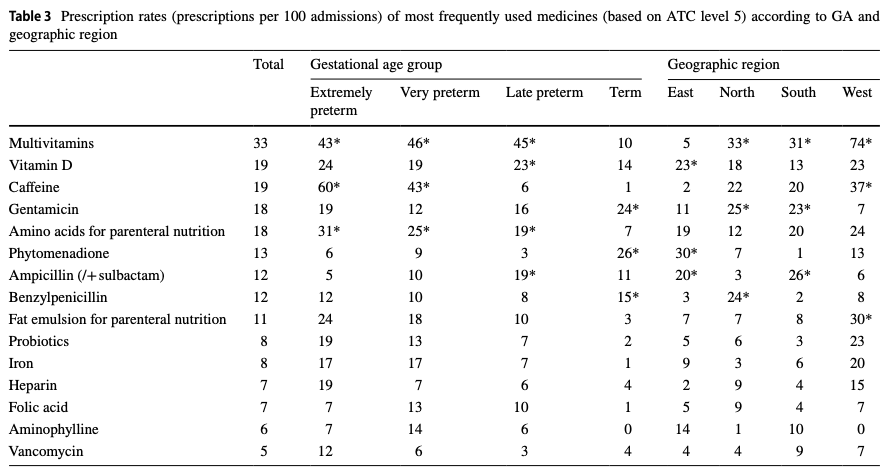
Vitamine sind die am häufigsten verschriebene Pharmaka, wobei unklar ist, warum in machen Regionen 74% und in andern nur 5% Vitamine verschreiben. Wenn es generall notwendig wäre, warum dann nicht 100%? Und wenn es nicht notwendig ist, warum dann nicht 0%?
Together with many other colleagues I was astonished about the Nestle booth at EAACI / PAAM 2019 conference in Florence.
The advertisement of Nestle for the NAN HA formula (“state-of-the-art routine infant formula“, „proven to reduce the risk of atopic dermatitis“, „long term effects up to 15 years of age“) along with other milk marketing violates recommendations of the WHO and other medical organisations about breast-feeding. None of the claims made is justified from a scientific viewpoint.
Having paid 650 € entry fee for a 3 day conference, it is also not acceptable that Dr Antonella Muraro (Padua) explains in Symposium 9 “Special products for cow’s milk allergy“ that if Nestle would not be sponsoring the event, the congress fees would be even higher.
At present, there is no generally accepted benefit of any baby food on long-term allergy prevention while also the therapeutic benefit is questionable. Commercial baby food may even increase later allergy by including supplements that are itself allergenic.
We therefore recommend a review of the EAACI ethics guidelines of industry sponsorship, and an immediate action against further participation of Nestle at future EAACI allergy congresses.
There are many immunological differences in humans and mice (follow my link) that are never discussed — not even in Science 2015;349/6252:1106.
Ignoring the long-standing paradox that endotoxin is also acting as a natural adjuvant to atopic inflammation, the credibility of the Science paper is further reduced.
IMHO it is also a strange experimental condition to have all animals on a standard vitamin D diet – a known co-sensitizers – and looking then for A20 which is co-regulated by vitamin D ??
And here is the last argument – more than 90% of studies in mice fail to translate into humans.
“Lebensgefährlicher Vitamin-D-Mangel: Neue Studie veröffentlicht erschreckende Zahlen” wird auf infranken.de/epaper mit passender Werbung für Vitamin D versehen.
Dabei sind wohl mehr Menschen an Überdosierung gestorben , als an einem Vitamin D Mangel (Vitamin D ist im übrigen in hoher Dosierung auch ein Rattengift). Vitamin D Supplemente hatte in vielen Interventionsstudien keinen Vorteil in Bezug auf Mortalität gezeigt, Bluttests dienen nur dem Arzt, der sie durchführt, so die Zusammenfassung im britischen Ärzteblatt BMJ.
Die Mortalität lässt sich nicht durch Vitamin Pillen senken, nur in 2 von 52 Studien gab es eine niedrigere Mortalität und das auch nur in einer Subgruppe (wobei der Effekt in den Originalarbeiten nicht signifikant war).
Und was steckt nun hinter dieser neuen Meldung? Es ist ein Vortragsabstract eines Wiener Facharztes für Haut und Geschlechtskrankheiten, der auf der Tagung einer Diabetesgesellschaft vorgestellt wurde. Also kein Endokrinologe, kein Vitamin Experte, kein Epidemiologe. Damit ist das auch keine Interventionsstudie, nicht mal vernünftig publiziert, nur der Abstract einer “Record Linkage Studie”
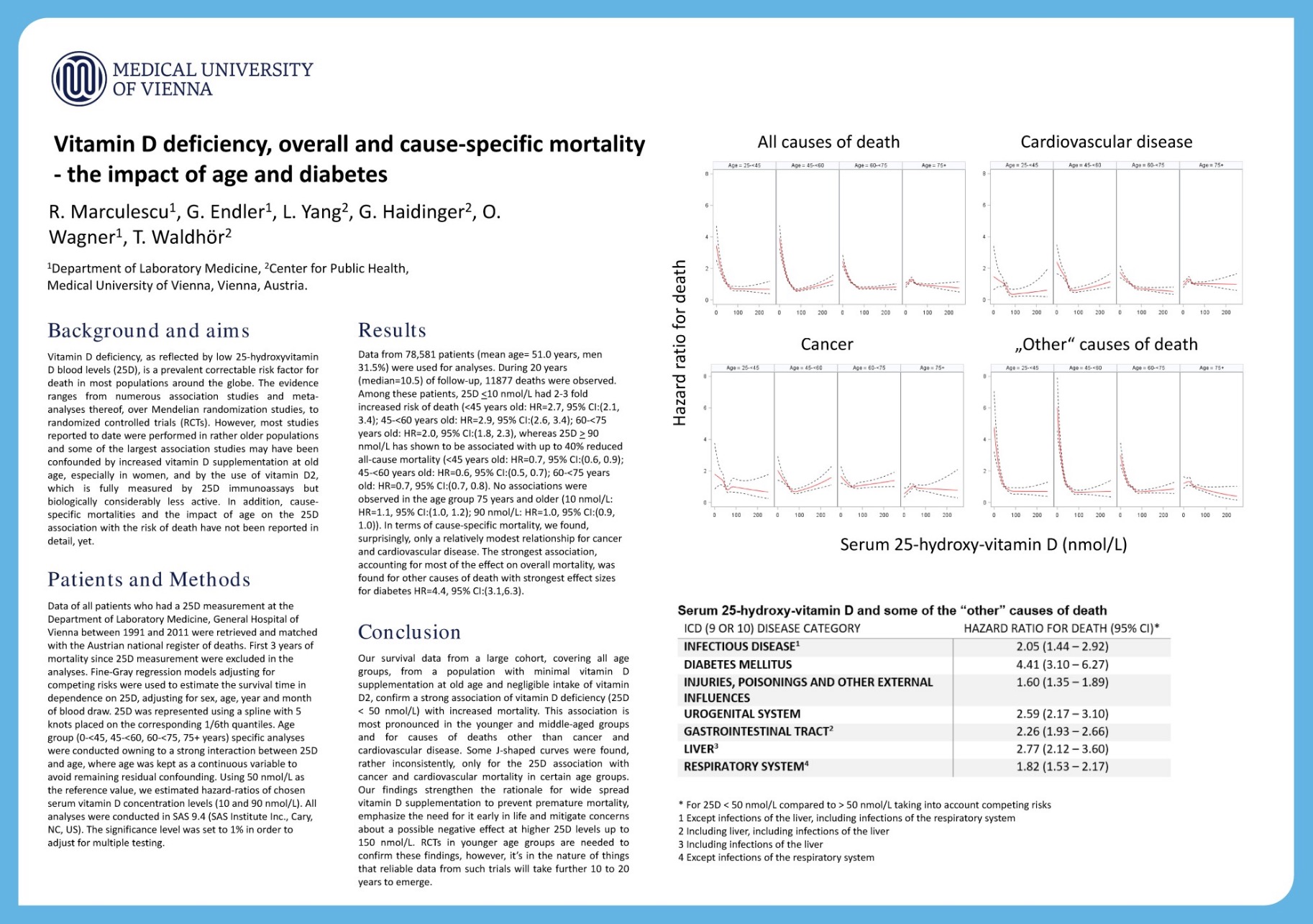
Dabei wurden Messwerte eines Kliniklabors mit Daten aus dem österreichischen Sterberegister verknüpft. Offensichtlich ist das in Österreich erlaubt, bleibt aber dennoch sinnfrei, wenn man A. weiss, dass Vitamin D ein Aktivitäts- und Inflammationsmarker ist und wenn man B. irgendwann im Leben einmal etwas über Berkson Paradox gehört hat. Warum wohl die ersten 3 Jahre von der Analyse ausgeschlossen wurden, weil die Mortalität da exzessiv gestiegen ist? Ich verstehe die Grafik nicht ganz, da sie nicht zur Methode passt – was ist denn nun die Referenzkategorie für das Hazard Ratio?
Irgendwie hätte es auch den Autoren auffallen müssen – dass es solche exzessiven HRs für Mortalität im echten Leben nicht gibt Natürlich wird jemand früher sterben, der kränker ist, schliesslich ist auch CRP bei Diabetes ein Prädiktor für Mortalität. Aber wen interessiert das ganze denn??
Mittlerweile wird auf Kongressen jeder halbwegs formal korrekte Abstract akzeptiert, um die Kongressgebühren zu kassieren. Auch eurekalert.org sollte das doch wissen, bevor es so eine Information weiter verbreitet. Viele Redaktionen können sich keinen Wissenschaftsredakteur mehr leisten. Und so schlägt dann alles ungefiltert beim Konsumenten ein “Lebensgefährlicher Vitamin-D-Mangel: Neue Studie veröffentlicht erschreckende Zahlen“. Und Herr Marculescu freut sich, da die Vitamin D Tests weiter ansteigen.
17 Okt 2019
infranken.de steigert sich mit derselben Nachricht unter weiteren URLs zur Clickbait Höchstform “Vitamin-D-Mangel kann tödlich sein: Eine Studie veröffentlicht schockierende Zahlen”.
There is an interesting meta-analysis at JAMA Pediatrics about vitamin D supplementation during pregnancy and offspring growth, morbidity, and mortality. Nothing special, standardized methodology and even somewhat expected outcome.
In this systematic review and meta-analysis of 24 randomized clinical trials including 5405 individuals, vitamin D supplementation during pregnancy was associated with a lower risk of infants being small for gestational age and improved growth during infancy without an increased risk of fetal or neonatal mortality or congenital abnormality.
More interesting are the vitamin D lobbyists writing the accompanying editorial (Bo Chawes , Klaus Bønnelykke, Hans Bisgaard) . They try by nearly every sentence to devalue the findings of the meta-analysis. They are even getting to the point of
no adverse effects have been found
We don’t see things as they are, we see them as we are.