Rotten Baby Milk

I have criticized in the past the milk industry sponsored research that is now operating at a similar scale like research funded by cigarette industry [1]. And well, it seems that I am not alone here when reading a new CEA paper “Are paediatric allergy services promoting or harming public health?”

There were increasing and excessive sales of specialized formula designed for infants with milk allergy—either extensively hydrolysed or amino acid formula. These represented 7.6% of formula sold in 2019 … Although pediatric allergy services cannot be held solely to blame for whole population trends, there is evidence that the clinical guidance used in pediatric allergy clinics might promote or exacerbate these trends. Moreover, many allergy, gastroenterology and pediatric societies and professionals routinely flaunt public health guidance from the World Health Organization by continuing to accept funding from formula companies, despite World Health Assembly resolutions that such conflictive relationships should be avoided.


CC-BY-NC Science Surf accessed 17.01.2026

Ist Sci-Hub legal?

Nein, ist es nicht – so das Amtsgericht München vom 31.1.2022 mit  Az:21 O 14450/17 das aber auch sagt:

Im Übrigen wird die Klage abgewiesen.

Sci-Hub ist auch nach dem jüngsten BGH Entscheid vom 13.10.2022 Az:I ZR 111/21 nicht legal, allerdings wird auch hier der Kläger abgewiesen:

Welche Anstrengungen zur Inanspruchnahme des Betreibers der Internetseite und des Host-Providers zumutbar sind, ist eine Frage des Einzelfalls.

Ist die Benutzung von Science-Hub unmoralisch? Nutzer in Afrika oder Südamerika werden diese Frage anders beantworten, als Nutzer in Europa oder Nordamerika. Continue reading Ist Sci-Hub legal?


CC-BY-NC Science Surf accessed 17.01.2026

Virchow’s experiences with epidemics radicalized him

Ed Yong speaks from the bottom of my heart in his Atlantic essay “What Even Counts as Science Writing Anymore?

Virchow’s experiences with epidemics radicalized him, pushing the man who would become known as the “father of pathology” to advocate for social and political reforms. COVID-19 has done the same for many scientists. Many of the issues it brought up were miserably familiar to climate scientists, who drolly welcomed newly traumatized epidemiologists into their ranks. In the light of the pandemic, old debates about whether science (and science writing) is political now seem small and antiquated. Science is undoubtedly political,


CC-BY-NC Science Surf accessed 17.01.2026

Pitbull reviewer

Virginia Walbot “Are we training pit bulls to review our manuscripts?”

Who hasn’t reacted with shock to a devastatingly negative review of a manuscript representing years of work by graduate students and postdoctoral fellows on a difficult, unsolved question? … dismissing the years of labor and stating that the manuscript can only be reconsidered with substantially more data providing definitive proof of each claim. … Your manuscript is declined, with encouragement to resubmit when new data are added.
I confess. I’m partly responsible for training the pit-bull reviewer, and I bet you are too.


CC-BY-NC Science Surf accessed 17.01.2026

How to push the impact of 2,299 scientists with 8,000 citations each?

Answer: Be co-author of an autophagy guideline

this is another episode of guidelines paper. More participants listed here – Affiliations listed stopped at 2299 – this means that there are 2299 authors in the manuscript. Unbelievable – how did they manage to get a consensus on what is written. May the first author explain, how the authorship on this guidelines is decided?


CC-BY-NC Science Surf accessed 17.01.2026

Face à Gaïa


Bruno Latour (* 22. Juni 1947 in Beaune; † 9. Oktober 2022 in Paris)

Jonas Salk in the foreword of “Laboratory Life – the Construction of Scientific Facts” 1986:

Scientists often have an aversion to what nonscientists say about science. Scientific criticism by nonscientists is not practiced in the same way as literary criticism by those who are not novelists or poets …  A love-hate relationship exists toward scientists in some segments of society. This is evident in accounts that deal with facets ranging from tremendously high expectations of scientific studies to their cost and their dangers—all of which ignore the content and process of scientific work itself …  For myself, it was interesting to have Bruno Latour in our institute, which allowed him to carry out the first investigation of this kind of which I am aware…

“Laboratory Life” focuses on the question how the objects of scientific study are socially constructed within the laboratory where they enter a “cycle of credibility” by accumulating recognition, honors, funding and prestige. But is there any truth or is this just a scientific culture remains an open question.


CC-BY-NC Science Surf accessed 17.01.2026

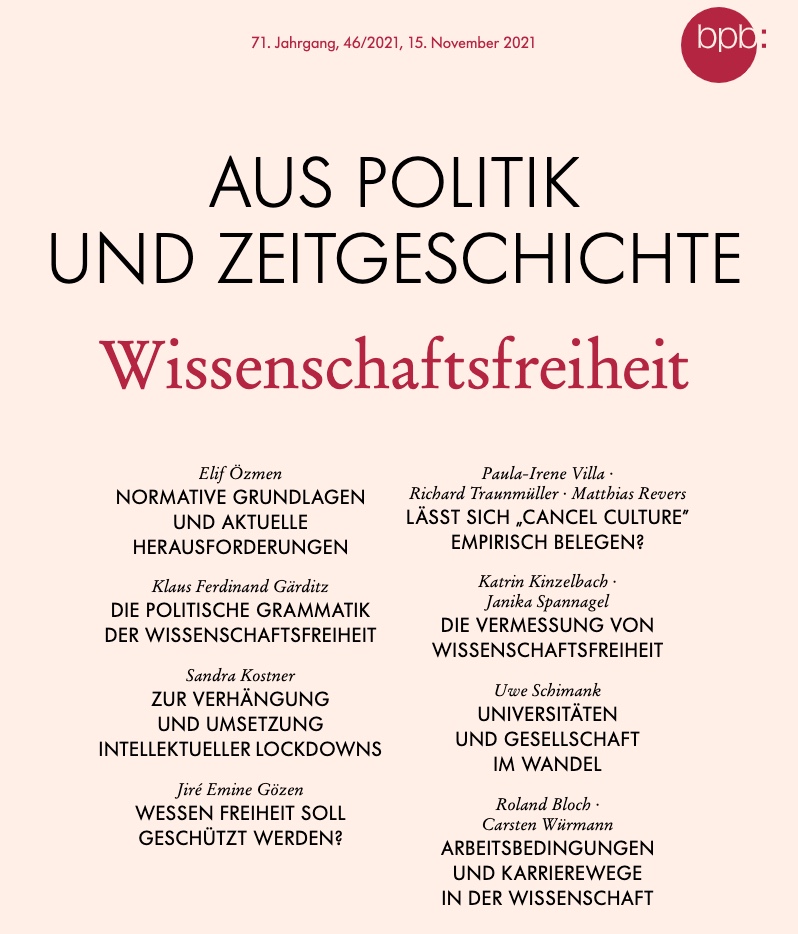
Das gemeinsame wissenschaftliche Ethos

Lesenswert!

https://www.bpb.de/system/files/dokument_pdf/APuZ_2021-46_online_0.pdf
[Es ist … ] unbestreitbar, dass ein gemeinsames wissenschaftliches Ethos und eine geteilte akademische Kultur die Grundlage für die Möglichkeit und den Bestand von epistemischen Freiräumen bilden. Diese Freiräume, auf die Wissenschaft angewiesen ist und die durch die Rechtsordnung allein nicht garantiert werden können, sind Räume der Gründe. Hier sind die rationalen Gütekriterien hoch, die Vorwegnahme der Gegenposition zur eigenen und deren ernsthafte Reflexion der wissenschaftliche Idealfall. Der Rede folgen gemeinhin Kritik und Gegenrede; eine sachbezogene Beharrlichkeit (statt Ablenkung, Themenwechsel, bullshitting) ist der diskursive Standard. Daher ist die „große Gereiztheit“, die Teile der aktuellen Debatte um Wissenschaftsfreiheit charakterisiert, der Wissenschaft wesensfremd, ebenso wie antagonistische Selbstverortungen (links vs. rechts, wokevs. boomer, Freunde vs. Feinde der Wissenschaft).


CC-BY-NC Science Surf accessed 17.01.2026

The slow abandonment of the academic mindset

Mittelman  on the  “The World-Class University and Repurposing Higher Education” 2018:

… the central academic purposes of the university are imperiled. While not universally adopted, they began to take root in the nineteenth century, developed gradually in the nineteenth and twentieth, and encounter novel tensions in the twenty-first. In this century, the triad of core educational missions in nonauthoritarian societies—cultivating democratic citizenship, fostering critical thinking, and protecting academic freedom — is losing footing. A new form of utilitarianism is gaining ground. It prioritizes useful knowledge and problem-solving skills at the expense of basic inquiry…

A few pages later Mittelman notices that universities

… have become preoccupied with strategic planning, benchmarking, branding, visibility, rankings, productivity indices, quality assurance systems, students as customers, and measurable outcomes. Before the 1980s, members of the higher education community rarely expressed themselves in these terms.

And it is true – we have been struggling even after 1980 with the mysteries of nature, by designing experiments and studies, trying to make new discoveries and teaching them to our students.

Fast rewind to the “idea of  a university” and the “cultivated intellect” by John Henry Newman (p15) and the usefulness of useless knowledge  of Abraham Flexner. In the last century clearly a need for unanticipated outcome was felt while today basically every research program starts with  a lengthy introduction that this is the most important research because disease D is so frequent or technology T is so important for the environment. Mittelman quotes Daniel Zajfman, 10th president of Israel’s Weizmann Institute, when talking about university rankings

When we look at the values of knowledge for the sake of knowledge, we realise 100 years later what we can do with this. If you look at the history of science, you will find that most of the discoveries were never made by trying to solve a problem, rather by trying to understand how nature works, so our focus is on understanding.


CC-BY-NC Science Surf accessed 17.01.2026

Ein mathematischer Gottesbeweis

Ein mathematischer Gottesbeweis geht zurück auf Guido Grandi und  wurde vor kurzem wieder mal ausgegraben von u/Prunestand bzw Cliff Pickover.

0 = 0 + 0 + 0 + ...
  = (1-1) + (1-1) + (1-1) + ...
  = 1 - 1 + 1 - 1 + 1 - 1 + ...
  = 1 + (-1 + 1) + (-1 + 1) + (-1 + 1) + ...
  = 1 + 0 + 0 + 0 + ...
  = 1

was letztendlich einer Schöpfung aus dem Nichts entspricht wo doch eigentlich “nihilo ex nihilum” gilt.

Die Grandi-Reihe hat nur leider keinen Summenwert, weil sie nicht konvergent ist. Anders gesagt

0 + 0 + 0 + ...                          # N Elemente
(1-1) + (1-1) + (1-1) + ...              # 2N Elemente
1 - 1 + 1 - 1 + 1 - 1 + ...              # 2N Elemente
1 + (-1 + 1) + (-1 + 1) + (-1 + 1) + ... # 2N + 1 Elemente
1 + 0 + 0 + 0 + ...                      # N + 1 Elemente

dh die 4. Zeile enthält eine falsche Aussage.

Frustriert oder erleichtert? Auf arXiv geht es weiter mit Gödels Gottesbeweis.


CC-BY-NC Science Surf accessed 17.01.2026