Allergy starts only after birth

Although there are numerous reports and even whole schools of thought building on a prenatal origin of allergy, a new study now clearly states that sensitization does not develop in utero. IgE traditionally measured in cord blood IgE is a contamination of maternal IgE. The authors show that there is a correlation with IgA and the “spurious specific IgE” at birth “vanishes” during the following 6 months. If you ever had a cord in hand, you will understand how easily contamination occurs.

Addendum 12/10/2008

The “prenatal origin” party doesn’t give up basically with the arguments:

  • no Ig A found that would be indicative of contamination BUT unfortunately their Ig A threshold of 32 ug/mL is not really appropriate
  • more than half of their cord blood samples have IgE negative mothers BUT unfortunately they don’t show the unclassified IgE values (is that’s just an artifact of a normal test variation?)
  • some of their cord blood samples have higher IgE levels than the mothers BUT again the same argument of an arbitrary classification applies
  • most single IgE results are not concordant between mother but they admit concordant results at least for food allergens. This may indeed been taken as an argument against simple cord blood contamination of ALL samples. As the accompanying editorial points out an in vivo translocation of immune complexes of IgG:allergen+IgE of a food allergens (that are nearly always present in contrast to some seasonal allergens) may be possible
  • the discussion ignores more or less the fact that there is definitely NO concordance with the father (as shown in table I) so leakage or contamination is likely

The authors explain the maternal/fetal association “by maternal inheritance of atopic IgE responsiveness on chromosome 11q and other gene loci” BUT unfortunately there is neither atopic IgE responsiveness on chromosome 11q nor is there any evidence of imprinting. So – according to our best evidence allergy starts only after birth. To convince me it would not need 922 neonates but 1 B cell of proven fetal origin that makes IgE – making the whole story at least a good example how insufficient methods produce doubtful conclusions, yea, yea.
 

CC-BY-NC Science Surf , accessed 25.03.2026

If pigs could fly

is a book that I am currently reading. There is also a brief German/English account how this sentence came into life. What did you expect when reading the title??

Something like “winners don’t punish”? A smart letter in this week’s Nature with the 3 options of Cooperation(C) – Defection (D) and Punishment (P)?

"nice people"
player 1: C C C C
player 2: C C C C top payoff!
"punish and perish"
player 1: C P P P P
player 2: C D D D D extremely bad!
"turning the other cheek"
player 1: C C C C C
player 2: D D C C C payoff still positive!

we should have known this earlier…

Addendum

link to an earlier post here on “tit for tat”
link to “vengeance is ours” at Edge
link to “sermon on the mount”
link to “Prisoner’s dilemma


CC-BY-NC Science Surf , accessed 25.03.2026

Calcium gradient in skin, vitamin D and filaggrin

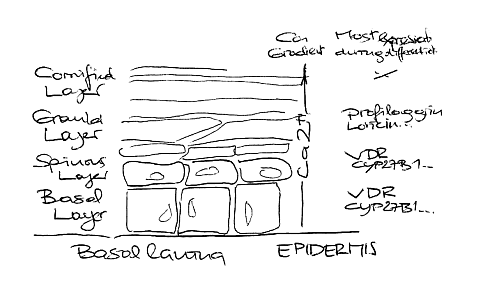
As filaggrin – one of our best atopy genes – is vitamin D dependent, I tried to find out more about epidermal differentiation. The plot here summarizes an earlier review:
cagradient.png
There seems to be a clear calcium gradient with the expression of differentiation specific marker in the single strata. So there is some good chance that filaggrin effects may be modified by external vitamin D supply.


CC-BY-NC Science Surf , accessed 25.03.2026

Central limit theorem

The central limit theorem states that a sum of independent identically distributed random variables (lets say allele counts in genomewide association scans) of finite variance will be approximately normally distributed. Unfortunately the maximum of the distribution will not reflect the true value … or did I get it wrong?


CC-BY-NC Science Surf , accessed 25.03.2026

Evolutionary psychology and science: The full error list

The appendix of Frey includes a list of errors based on evolutionary psychology (EP) – some acquired during development of our species, some acquired during individual ontogenesis. It is certainly the best what I have read since the famous study biases Continue reading Evolutionary psychology and science: The full error list


CC-BY-NC Science Surf , accessed 25.03.2026

Is there any environmental conditioning of vitamin D metabolism?

So far, I haven’t seen so much work about epigenetic regulation of vitamin D. There was already a paper in 2005 that showed how treatment with the

methylation inhibitor 5-aza-2′-deoxycytidine together with the deacetylation inhibitor trichostatin A resulted in elevation of both CYP27B1 and CYP24 mRNA expression demonstrating that even in normal human prostate cells expression of Vitamin D hydroxylases may be under epigenetic control

Continue reading Is there any environmental conditioning of vitamin D metabolism?


CC-BY-NC Science Surf , accessed 25.03.2026

Severe flaw in mouse allergy studies

A report in Biospektrum 07.07/13:762 about the production of endotoxin free ovalbumin by a German company now reveals that nearly all commercially available ovalbumin preparations are highly contaminated with endotoxin. Company A included 723, company B 1038, company C 257 and company D 342 EU/mg LPS. As all mice are usually also on a vitamin D supplement diet, recent mouse studies may have produced largely artifacts if both – agonist and antagonist – are included in an uncontrolled manner, yea, yea.


CC-BY-NC Science Surf , accessed 25.03.2026

Bias against negative studies

We probably all agree that a publication bias against negative studies will severely distorts our opinion. To repeat an earlier Nature letter

Why negatives should be viewed as positives … This filtering of results undoubtedly biases the information available to scientists (see, for example “Null and void” Nature 422, 554–555; 2003). And communication is at the heart of science.

Here is an email that I received from the editor Continue reading Bias against negative studies


CC-BY-NC Science Surf , accessed 25.03.2026

Yes, it is true and and quite right too

Science reports that the NEJM is being sued by Pfizer

in various jurisdictions on product liability grounds. Plaintiffs are claiming that its products Celebrex and Bextra cause cardiovascular and other injuries. Pfizer asserts that in some cases plaintiffs are making use of published papers from the New England Journal of Medicine (NEJM). So it wants to dig though the confidential reviews of those papers in search of something to strengthen its defense.

Two giants fighting each other… Continue reading Yes, it is true and and quite right too


CC-BY-NC Science Surf , accessed 25.03.2026

Phantastic, the peer-review system is broken

A comment on the online Nature website says it all

Phantastic. Moreover, the peer-review system is broken with top PI’s getting away with publishing high impact poorly reviewed rubbish. If more non-peer-reviewed research becomes more prominent it will hardly make a difference to quality and can overall only be a good thing.

commenting on the recent decision at Harvard to automatically publish all papers by its Faculty of Arts and Sciences on the university’s website (except there is a waiver). I am waiting for the first German university to follow; effectively since January 2008 we get all our ordered documents on paper again for copyright reasons.


CC-BY-NC Science Surf , accessed 25.03.2026

SuperSAGE plus highly parallel sequencing

Current RNA chip technology, although quite advanced, is usually limited to known transcripts. As rare transcripts (N=1 to 5) usually cannot be quantified, current chip technology is probably useless for building realistic virtual cells. Maybe there are there are other options? SAGE – serial analysis of gene expression – has been also around Continue reading SuperSAGE plus highly parallel sequencing


CC-BY-NC Science Surf , accessed 25.03.2026

Un altro giro di giostra

This is the book that I am currently reading – a monologue of the world famous journalist Tiziano Terzani – who describes at the end of his life his view of the “scientific” medical approach at MSKCC, the achievements but also shortcomings. “Un altro giro di giostra”.


CC-BY-NC Science Surf , accessed 25.03.2026