Category Archives: Allergy

Herrmann von Helmholtz on the cure of hayfever

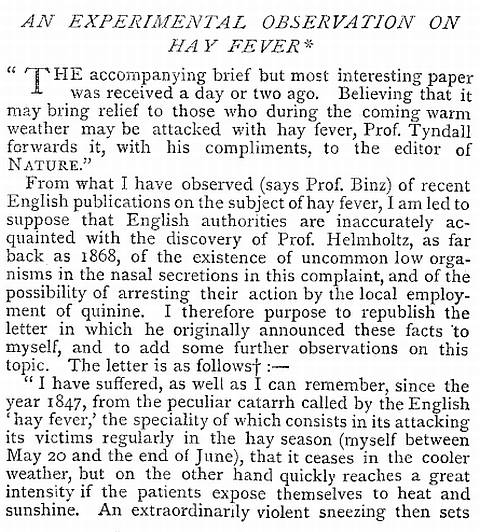
It was difficult to find but I knew it should be there: a letter of Herrmann von Helmholtz about his private attempt to cure hay fever. Published in the increasingly important Nature magazine on May 14, 1874 von Helmholtz describes the vibrio like bodies in his own nasal fluid and the successful local treatment with quinine.

Unfortunately there is a consecutive letter that did not confirm this effect. I also do not know how this treatment would have worked. Fiction, placebo or true antiparasitic side-effect? We even know of quinine induced allergy, making even reverse causation possible.

G. Kanny, J. Flabbée, M. Morisset M, D. Moneret Vautrin. Allergy to quinine and tonic water. Eur J Intern Med 14 (2003), p. 395-396.
R. Cundall, Idiosyncrasy to quinine in bitter lemon. Br Med J 20 (1964), p. 1638.


CC-BY-NC Science Surf accessed 18.12.2025

Create your own Garmin vector map

It turned out to be a tricky job to move from pixel maps to a Garmin vector map; I first thought that is impossible but here is a way to do that:
1. Find the area of interest with Geocoder
2. Get digital elevation data from de Ferranti
3. Import them in 3DEM, export as GEO-TIFF, import in DEM2TOPO and export in Polish map format.
4. Finalize with Mapedit. Mapedit will read Polish format, import your already available GPS tracks or positions saved in Oziexplorer. The best Mapedit feature is certainly the Google Earth overlay. Nevertheless map editing remains a time consuming enterprise but may be the only way if there is no other map available. I wish there would be more of these maps like for Iceland or Garda Lessinia.


CC-BY-NC Science Surf accessed 18.12.2025

A factor in hay prevents vitamin D action

As always, a longer literature search prevents from new discoveries… Here comes a nice piece from 1952 on the antagonistic effect of LPS on vitamin D (Is that really LPS or did I interpret it wrong?). Although not included in my recent review on vitamin D and allergy – I attributed the effect to Lyakh et al. – here is the first description of this effect. Continue reading A factor in hay prevents vitamin D action


CC-BY-NC Science Surf accessed 18.12.2025

Allergy starts only after birth

Although there are numerous reports and even whole schools of thought building on a prenatal origin of allergy, a new study now clearly states that sensitization does not develop in utero. IgE traditionally measured in cord blood IgE is a contamination of maternal IgE. The authors show that there is a correlation with IgA and the “spurious specific IgE” at birth “vanishes” during the following 6 months. If you ever had a cord in hand, you will understand how easily contamination occurs.

Addendum 12/10/2008

The “prenatal origin” party doesn’t give up basically with the arguments:

  • no Ig A found that would be indicative of contamination BUT unfortunately their Ig A threshold of 32 ug/mL is not really appropriate
  • more than half of their cord blood samples have IgE negative mothers BUT unfortunately they don’t show the unclassified IgE values (is that’s just an artifact of a normal test variation?)
  • some of their cord blood samples have higher IgE levels than the mothers BUT again the same argument of an arbitrary classification applies
  • most single IgE results are not concordant between mother but they admit concordant results at least for food allergens. This may indeed been taken as an argument against simple cord blood contamination of ALL samples. As the accompanying editorial points out an in vivo translocation of immune complexes of IgG:allergen+IgE of a food allergens (that are nearly always present in contrast to some seasonal allergens) may be possible
  • the discussion ignores more or less the fact that there is definitely NO concordance with the father (as shown in table I) so leakage or contamination is likely

The authors explain the maternal/fetal association “by maternal inheritance of atopic IgE responsiveness on chromosome 11q and other gene loci” BUT unfortunately there is neither atopic IgE responsiveness on chromosome 11q nor is there any evidence of imprinting. So – according to our best evidence allergy starts only after birth. To convince me it would not need 922 neonates but 1 B cell of proven fetal origin that makes IgE – making the whole story at least a good example how insufficient methods produce doubtful conclusions, yea, yea.


CC-BY-NC Science Surf accessed 18.12.2025

Calcium gradient in skin, vitamin D and filaggrin

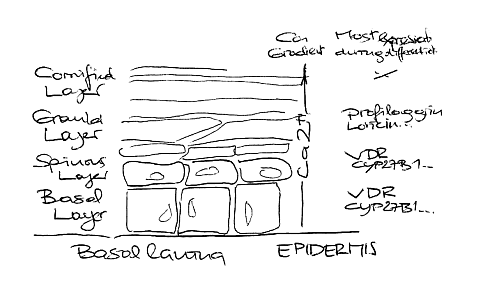
As filaggrin – one of our best atopy genes – is vitamin D dependent, I tried to find out more about epidermal differentiation. The plot here summarizes an earlier review:
cagradient.png
There seems to be a clear calcium gradient with the expression of differentiation specific marker in the single strata. So there is some good chance that filaggrin effects may be modified by external vitamin D supply.


CC-BY-NC Science Surf accessed 18.12.2025

Severe flaw in mouse allergy studies

A report in Biospektrum 07.07/13:762 about the production of endotoxin free ovalbumin by a German company now reveals that nearly all commercially available ovalbumin preparations are highly contaminated with endotoxin. Company A included 723, company B 1038, company C 257 and company D 342 EU/mg LPS. As all mice are usually also on a vitamin D supplement diet, recent mouse studies may have produced largely artifacts if both – agonist and antagonist – are included in an uncontrolled manner, yea, yea.


CC-BY-NC Science Surf accessed 18.12.2025

Parascience in nature medicine?

I wonder about the title of a new nature medicine editorial

Breathing easier with breast milk

It is not so much the unwanted analogy to aspiration; the paper simply hasn´t to do anything with breathing. It is a poor narrative of a concomittant NM article repeating many of its prejudices. Although the authors would like to let you belief that they have discovered allergen transfer into breast milk, this is known Continue reading Parascience in nature medicine?


CC-BY-NC Science Surf accessed 18.12.2025

Tis strange – but true; for truth is always strange

This Byron quotation is taken from the foreword of Selye “Calciphylaxis” 1962 and may help to introduce the followup story on the question who described for the first time vitamin D as cofactor in the allergic sensitization process. Continue reading Tis strange – but true; for truth is always strange


CC-BY-NC Science Surf accessed 18.12.2025

Atopic march to a dead end

“.. or does the theory really have legs?” is the title of a critical editorial in JMCP last month. Although I will co-author a forthcoming paper on allergic rhinitis being a risk factor for later asthma, the situation is far from being understood. “March” implies a command for all to go into one direction which is arguable a poor analogy Continue reading Atopic march to a dead end


CC-BY-NC Science Surf accessed 18.12.2025