That’s one small step for (a) man, one giant leap for mankind

The BBC headline yesterday is close to the famous quote of Neil Amstrongs’ with reporting the United States blocking now genetic discrimination.

Or as Kennedy put it forward “the first new civil rights bill of the new century”. Unfortunately, we are lagging behind in Europe. My recent initiative to promote such a legislative in Germany was futile; the most recent goverment proposal only earned a lot of criticism.


CC-BY-NC Science Surf , accessed 25.03.2026

Personal Genome Explorer

Laborjournal 4/2008 reports a new software tool for DNA addicted people: the Personal Genome Explorer which is based on SNP annotation by SNPedia. So, what I tried to institutionalize on a sound level as “Genome Explained” possibly within the framework of HGVS is now being done by a street initiative fueled by early adopters like Cross, Arlington, Halamka and Smolenyak. It looks very much like an unholy alliance of profit interests and technical curiosity than good science and responsible counseling, yea, yea.
Addendum: If you believe in support vector machines, you can even let your laptop screen the medical literature for genetic associations with GAPscreener. <irony> No more lengthy training in genetics, statistics, epidemiology and bioinformatics, no more years of collecting all relevant papers & abstracts, just let your laptop score your DNA variants </irony>


CC-BY-NC Science Surf , accessed 25.03.2026

Our lives are unrepeatable experiments lacking a control

a prosaic quotation from the recent Nature correspondence section that highlights why genetics has been leading us into nowhere.

Our lives are unrepeatble experiments lacking a control. Myriad external factors interact with genetic and epigenetic factors and with chance to determine whether we are well or ill, smart or dull, successes or failures.

Yea, yea.


CC-BY-NC Science Surf , accessed 25.03.2026

Herrmann von Helmholtz on the cure of hayfever

It was difficult to find but I knew it should be there: a letter of Herrmann von Helmholtz about his private attempt to cure hay fever. Published in the increasingly important Nature magazine on May 14, 1874 von Helmholtz describes the vibrio like bodies in his own nasal fluid and the successful local treatment with quinine.
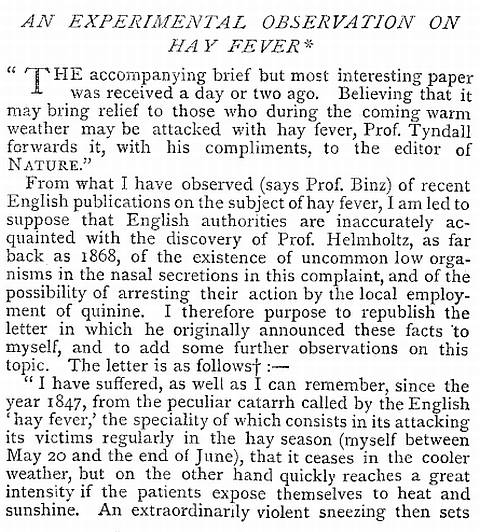
Unfortunately there is a consecutive letter that did not confirm this effect. I also do not know how this treatment would have worked. Fiction, placebo or true antiparasitic side-effect? We even know of quinine induced allergy, making even reverse causation possible.

G. Kanny, J. Flabbée, M. Morisset M, D. Moneret Vautrin. Allergy to quinine and tonic water. Eur J Intern Med 14 (2003), p. 395-396.
R. Cundall, Idiosyncrasy to quinine in bitter lemon. Br Med J 20 (1964), p. 1638.


CC-BY-NC Science Surf , accessed 25.03.2026
How we are reshuffling our genome

is an exciting question that will have a large disease relevance. I think this is not so much about cytogenetic abnormalities but the general understanding which genetic modules are recombining, e.g. are compatible in terms of function, and which need to be tight together. Continue reading How we are reshuffling our genome


CC-BY-NC Science Surf , accessed 25.03.2026

We are the model organisms

Genomeweb today reports Sidney Brenner (Nobel Prize winner 2002 and pioneer in the use of Caenorhabditis elegans as a model organism) speaking on a conference. These days he’s pushing a new model organism: humans.

“We don’t have to look for a model organism anymore,” Brenner said. “Because we are the model organisms.”


CC-BY-NC Science Surf , accessed 25.03.2026

To be honest

Bruce Alberts, the new editor-in-chief of Science magazine, has in his March, 21 editorial a nice comment that I would like to highlight here

Scientists share a common way of reaching conclusions that is based not only on the evidence and logic, but also requires honesty, creativity, and openess to new ideas.

Struggling in an area where no (or only seldom) conclusions ar being reached, I agree Continue reading To be honest


CC-BY-NC Science Surf , accessed 25.03.2026

Create your own Garmin vector map

It turned out to be a tricky job to move from pixel maps to a Garmin vector map; I first thought that is impossible but here is a way to do that:
1. Find the area of interest with Geocoder
2. Get digital elevation data from de Ferranti
3. Import them in 3DEM, export as GEO-TIFF, import in DEM2TOPO and export in Polish map format.
4. Finalize with Mapedit. Mapedit will read Polish format, import your already available GPS tracks or positions saved in Oziexplorer. The best Mapedit feature is certainly the Google Earth overlay. Nevertheless map editing remains a time consuming enterprise but may be the only way if there is no other map available. I wish there would be more of these maps like for Iceland or Garda Lessinia.


CC-BY-NC Science Surf , accessed 25.03.2026

A factor in hay prevents vitamin D action

As always, a longer literature search prevents from new discoveries… Here comes a nice piece from 1952 on the antagonistic effect of LPS on vitamin D (Is that really LPS or did I interpret it wrong?). Although not included in my recent review on vitamin D and allergy – I attributed the effect to Lyakh et al. – here is the first description of this effect. Continue reading A factor in hay prevents vitamin D action


CC-BY-NC Science Surf , accessed 25.03.2026