Putting ‘scientific’ on a bottle of tonic often just a money-making scheme

A reader of the Guardian is now better informed than many scientists

The fact that lots of healthy living schemes claimed to be scientific tells us something about the power, authority and appeal of science at the time. It’s easy to be cynical and suggest that putting ‘scientific’ on a bottle of tonic was just a crude money-making scheme – and sometimes that was the case. But clearly some of the people involved believed that they were right, and that they were doing important scientific or medical work. They had been trained in the same institutions and taken the same exams as their critics. So how could they disagree over whether they were ‘faddists’ or ‘scientists’? And how can we as lay people tell the difference?
Part of the problem is the difficulty in defining science. While it’s practised by all sorts of different people, with different qualifications in different places, one thing that’s supposed to be constant is the scientific method. Many scientists, and most of us who study science, recognise that there isn’t actually a single, unifying ‘Scientific Method’, but that doesn’t stop people trying to find it, and there’s a ‘common sense’ version that’s often suggested, which runs something like this:
(1) Form hypothesis (2) design experiment to test hypothesis (3) run experiment (4) adjust hypothesis according to results


CC-BY-NC Science Surf accessed 20.01.2026

A mistake in the operating room

Found at https://www.nature.com/articles/ncpuro0294#article-info via https://twitter.com/MaartenvSmeden/status/1071138625415458817

A mistake in the operating room can threaten the life of one patient; a mistake in statistical analysis or interpretation can lead to hundreds of early deaths. So it is perhaps odd that, while we allow a doctor to conduct surgery only after years of training, we give SPSS® (SPSS, Chicago, IL) to almost anyone. Moreover, whilst only a surgeon would comment on surgical technique, it seems that anybody, regardless of statistical training, feels confident about commenting on statis- tical data. If we are to bring the vast efforts of research to fruition, and truly practice evidence- based medicine, we must learn to interpret the results of randomized trials appropriately.


CC-BY-NC Science Surf accessed 20.01.2026

ICMJE Conflicts of Interest – spyware?

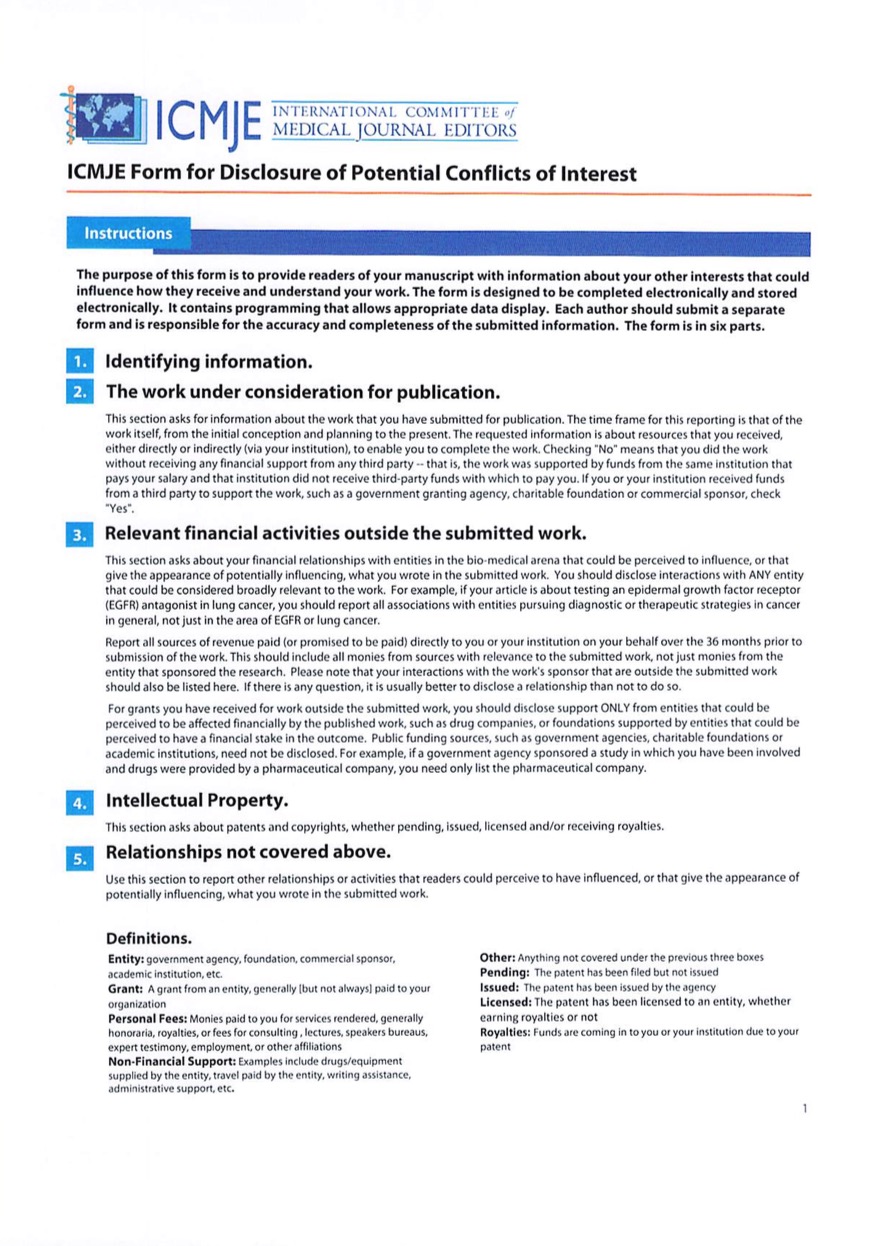
I dont’t understand why the ICMJE Conflicts of Interest of the Vancouver group is NOT distributed as a standard PDF but as an Adobe Form that can be opened only after installing a lot of unnecessary software that opens a lot of unnesssary ports transmitting a lot of unnecessary data. This is how it looks natively on a Mac


and this is how it should look like

Adobe Acrobat Reader DC does not even allow printing into a PDF, clearly spyware behavior forcing data collection on an unknown destination.


CC-BY-NC Science Surf
accessed 20.01.2026

Viel hilft viel

Immer wieder wird Deutschland ein flächendeckender Vitamin-D-Mangel attestiert. So schrieb beispielsweise die Deutsche Gesellschaft für Ernährung in ihrem Bericht, den sie im Sommer veröffentlichte, rund 30 Prozent der Erwachsenen seien nicht ausreichend mit Vitamin D versorgt. Wobei Ältere als Risikogruppe gelten und bei Seniorinnen der Mangel aber ausgeprägter ist als bei Männern. Für Personen mit hohem Risiko für einen Vitamin-D-Mangel erachtet es die DGE für notwendig, ein Vitamin-D-Präparat einzunehmen, um den Bedarf zu decken. Evidenz für eine generelle Substitution gibt es zwar nicht. Aber anscheinend führen solche Berichte und das zugehörige Medien-Echo dazu, dass eigenmächtig ohne Rücksprache mit Arzt oder Apotheker Vitamin D eingenommen wird – und zwar nach dem Motto: „viel hilft viel“

Wer glaubt schon der Deutsche Gesellschaft für Ernährung? Immerhin doch Einige: Die Deutschen Apothekerzeitung berichtet aktuell über zwei Fälle von akuten Nierenversagen bei ausgeprägter Hyperkalzämie,.


CC-BY-NC Science Surf
accessed 20.01.2026

All humans, and two ancestors?

Daily Mail reports a study in Human Evolution with comments at phys.org

A scientific study has prompted speculation that all modern humans could have descended from a solitary pair who lived 100,000 to 200,000 years ago.
Scientists surveyed the genetic ‘bar codes’ of five million animals – including humans – from 100,000 different species and the results have prompted speculation that we sprang from a single pair of adults after a catastrophic event almost wiped out the human race.
These bar codes, or snippets of DNA that reside outside the nuclei of living cells, suggest that it’s not just people who could have come from a single pair of beings, but nine out of every 10 animal species, too.

I have heard that before.


CC-BY-NC Science Surf
accessed 20.01.2026

The not so revolutionary phenotype

While scanning the internet for the crispr’d babies I found some bizarre accounts. One of these is “Revolutionary Phenotype” by Jean-Francois Gariépy, a book to appear in late 2018, and more fi than sci.

Suppose you want to have a child, but instead of reproducing in the traditional fashion, you and your mate opt to store your genetic information on a computer. Then, while your genes are digitally stored on the computer’s hard drive, you decide to make a few minor edits—just some slight improvements to ensure your kid will be healthy. You then dump your revised digital genome into a series of DNA molecules, which you inject into a human egg that has been stripped of its own native genome. Nine months later, your flesh- and-blood child is born, and you and your family proceed with your deeply satisfying life. You end up never regretting the decision you have made to modify a few genes in your child’s DNA. Your child likes it too since he has better health and strength compared to most of his peers. He’s already dreaming of having his own genetically- modified children.

Humans are not only determined by their genome. And the human genome is a bit more than a digital sequence. But maybe this misunderstanding is intended to increase sales.


CC-BY-NC Science Surf
accessed 20.01.2026

How does the soma to germline transfer work?

I never had problems to understand environmental induced sperm methylation as spermatozoa of animals are produced continuously by meiotic division.  But I learned that in humans all ova are produced before birth, so how could these ever be influenced by an environmental exposure? It seems that the dogma of prefabricated eggs is wrong as described already in 2012.

Rare mitotically active cells have a gene expression profile that is consistent with primitive germ cells. Once established in vitro, these cells can be expanded for months and can spontaneously generate 35- to 50-μm oocytes

So there is a lifelong chance that environmental exposures both in fathers and mothers can be transmitted to the offspring “fat eggs, fat offspring” – there is no Weismann Barrier. (This remains also an important question as somatic gegen therapy could accidentally introduced germline changes – at least in theory).

But how does any soma to germline transfer work? A new paper examined this  in more detail. They found that the negative regulator of sperm activation in C elegans, SWM-1, is produced in body wall muscle, then secreted into the body cavity. Whenever it enters the gonad it finds it target TRY-5, a spermiogenesis activator, that influences sperm success.

So to the more conventional soma to germline theories of persistent methylation changes or RNA fragments ( as described in a recent review) there maybe more possibilities like microbiome transfer.


CC-BY-NC Science Surf
accessed 20.01.2026

One of the things I’ve never done very well

According to chess24.com

Magnus Carlsen demolished Fabiano Caruana 3:0 in rapid tiebreaks on Wednesday to retain his World Championship title for another two years. He was defiant afterwards about his decision not to play on in Game 12, saying Garry Kasparov and Vladimir Kramnik were, “entitled to their stupid opinions”, while he explained, “one of the things I’ve never done very well is listen to other people’s advice. I’ve always gone my own way… and it’s brought me this trophy today!”


CC-BY-NC Science Surf
accessed 20.01.2026

Was bleibt

In erster Linie bleiben die spinnerten Menschen im Gedächtnis haften, vermutlich weil sie jene Welt verkörpern, die allein mit der Kraft des Verstandes nicht zu durchdringen ist (Hans Kratzer)


CC-BY-NC Science Surf
accessed 20.01.2026

Embed youtube videos without pre-loading any data

This short script is quite useful for DSGVO complaint, aeh compliant websites. Just put a grey picture in /images/externalcontent.png or wherever you want

/images/externalcontent.png

and insert a short script in the wordpress header.

function showyou() {
  $('iframe[name*=".com"]').each(function(e) {
    var src=$(this).attr('name');
    $(this).attr('src',src);
    $(this).show();
  });
}
$(document).ready(function(){
  $('iframe[src*=".com"]').each(function(e) {
    var src=$(this).attr('src');
    $(this).attr('name',src );
    $(this).attr('src','');
    $(this).after('<img class="me" src="/images/externalcontent.png" onclick="$(\'.me\').hide();showyou();"/>
');
    $(this).hide();
  });
});


CC-BY-NC Science Surf
accessed 20.01.2026

Der chinesische Menschenversuch

This content has restricted access, please email me for the password.


CC-BY-NC Science Surf
accessed 20.01.2026

Individuelle Wissenschaftsfreiheit und Organisationsbedürftigkeit von Wissenschaft

Zu dem Thema äussert sich auf S.21 die Empfehlung des Wissenschaftsrats 2018 zur Hochschulgovernance

Ein weiteres Merkmal von Hochschulen, welches zu Konflikten führen kann, ist die Beziehung zwischen der individuellen und der korporativen Wissenschaftsfreiheit. Damit die einzelnen Wissenschaftlerinnen und Wissenschaftler ihre Freiheitsrechte wahrnehmen können, sind sie auf einen organisatorischen Rahmen angewiesen, der die Ressourcenverteilung vornimmt, arbeitsteilige Prozesse in Lehre und Forschung organisiert, administrative Unterstützung leistet und die erforderlichen Infrastrukturen bereitstellt […] Eingriffe der Hochschulen in die individuelle Wissenschaftsfreiheit ihrer Mitglieder sind von der Verfassungsrechtsprechung ausdrücklich gebilligt worden. Sie „können insbesondere durch das Ziel der […] Erhaltung und Förderung der Funktionsfähigkeit der Hochschulen sowie des Schutzes anderer Grundrechtsträger gerechtfertigt sein“. Um jedoch zugleich die Trägerinnen und Träger der Wissenschaftsfreiheit in die Lage zu versetzen, ihre individuellen Autonomieansprüche wirksam zu vertreten, werden sie […] an vielen Entscheidungen direkt beteiligt. Das Bundesverfassungsgericht hat dem Gesetzgeber für die genaue Ausgestaltung der Mitwirkungs- und Kontrollrechte der Wissenschaftlerinnen und Wissenschaftler einen weiten Gestaltungsspielraum eröffnet […]

Das ist eindeutig formuliert.


CC-BY-NC Science Surf
accessed 20.01.2026